Friday, December 2, 2011

The Holiday Season's Garden

Powell Gardens is brimming with flowers, foliage and fruit that make this season bright.


The Conservatory and its Victorian-themed palate is full of unique Poinsettias and companion plants in a beautiful design by Horticulturist Anne Wildeboor. Here Poinsettia 'Winter Rose Marble' & 'Premium White' is set off by Diamond Frost Euphorbia and Pink Polka-dot Plant. If you are in the market for unique poinsettias, Perennial Gifts (our gift shop) will have these for sale for you to take home.


Outside the last of the season greens are part of our masterful foliage display playing off their leave's beautiful colors and textures. This marvelous array of edibles was designed by Horticulturist Matt Bunch in the Heartland Harvest Garden's Villandry Quilt Garden in front of the barn. From left to right the mustard greens varieites are: 'Golden Frill', 'Purple Rain', 'Green Wave' and 'Garnet Giant.'


No, the gardening season does not end with a freeze! Many of the "greens" of the fall garden hold well into December with some kale hardy to near 10F. Make sure to walk to the barn on your Powell Gardens visit to see some of these beautiful compositions and be sure and hike (or ride on the elevator) up to the top of the silo for a bird's eye overview of the landscape.


No, this is not a "beached" starfish but a gorgeous bed of greens (purple 'Garnet Giant' mustard and green tops of radishes)

in the Villandry Garden. The unique fringed edge are 'Chinese Ornamental' peppers which, though killed by a freeze, create a gorgeous border in the winter landscape.


The screaming red berries of the Possumhaw or Deciduous Holly (Ilex decidua) always warm the soul on a winter garden walk. All berried hollies are female and require a male pollinator -- when we planted this fruiting plant in the Perennial Garden we forgot to plant a pollinator and it still fruited! I thought we might have the first self-fruitful possumhaw but then we discovered a wild male plant in the woods nearby.


This Prairie Rose (Rosa setigera) in the Apple Celebration Court is also loaded with beautiful deep red hips. It is a companion planting to the apples and makes the garden beautiful all through winter.


Prickly-pears like this wild Bigroot Prickly Pear (Opuntia macrorhiza) draping over the living wall on the Island Garden are great for winter interest in the garden. The companion reddish foliage is from the Hardy Plumbago (Ceratostigma plumbaginoides) used as a colorful companion plant.


The Island Garden is choc full of neat foliage plant treats like this Angelina Sedum (Sedum reflexum) which in winter has orange hi-lights.


Angelina Sedum combines well with other evergreen plants like silver Santolina (back left), Candytuft (back right) and fine forest green creeping thyme (front left) and rich green six-sided sedum (front right). All these grow on top of the Island Garden's living wall.


Snowdrops (Galanthus elwesii) have already made their appearance on the Island Garden! Perhaps the severe drought of fall followed by copious rains fooled them into thinking it was spring. At any rate we sure enjoy these cold hardy, floral gems whenever they appear.


Sweet Violets (Viola odorata) are also in bloom with their intensely sweet perfume. They are awesome edible flowers with a sweet floral taste that can really make a salad sing in this season.
These were photographed on the east side of the Island Garden but they are also sweetening up the Kitchen Garden south of the barn in the Heartland Harvest Garden and a few other secret locations around the garden--your nose will find them before your eyes.

These flowers, foliage and fruit await your discovery on a holiday walk at Powell Gardens. Take a break from the hustle and bustle and discover the beauties of our winter garden.




Monday, November 21, 2011

Owls Banded at Powell Gardens

One of North America's smallest and most secretive (and cutest!) owls: the Northern Saw-whet Owl were banded at Powell Gardens last week. We invited staff from the Missouri River Bird Observatory to come sample appropriate habitat near the Byron Shutz Nature Trail where we thought the owls might reside. 2 owls were caught: one male near 9 p.m. and one female at 11:30 p.m.


Dana Ripper, Director of the Missouri River Bird Observatory (MRBO), shows off the male Northern Saw-whet Owl netted at Powell Gardens. Across North America, a network of researchers is monitoring the autumn migration of this tiny owl. Northern Saw-whet Owls were thought to be quite rare in our area but the MRBO is proving that we have more owls in central Missouri than previously known. Learn more at www.projectowlnet.org and visit the MRBO website at www.mrbo.org.

Here Dana relays information about the bird to Ethan Duke, Assistant Director of the Missouri River Bird Observatory. Each of the two owls caught were measured and weighed, checked for health, banded and released very near where they were caught. Based on the information gathered the first bird was a male and the second a female (you can't tell by their plumage). Both birds were more than a year old.

Dana holds out their relatively large wings to see their molt patterns. This bird weighed less than 3 ounces and can fly away with a mouse more than one third its weight.


Only professionals with proper permits may net and band these and all protected species of birds. Myself and a handful of Missouri Master Naturalists accompanied Dana and Ethan to the banding here at Powell Gardens. If you ever come across a banded bird (owl or any bird!) please report it to www.reportband.gov. I wondered what the story was with each of the Saw-whets caught here at Powell: where did you come from? From the high elevations of the Rocky Mountains? From the great northern forests of Canada? From Northern Minnesota? Were they planning to stay here for the winter or fly farther south? If only they could speak. The banders' research is helping us to understand the lives of secretive birds and put in place an understanding of what their conservation needs are now and for future generations.


Meet Dana and Ethan from the MRBO at Powell Gardens on Sunday, February 5th for banding birds around the Powell Gardens Visitor Center. It will be a chance for our visitors to get up close and personal to wild birds. Watch for specific details soon.

Monday, November 14, 2011

Colors of November

The low light of November creates some sublime scenes by intensifying the fall hues. A walk through Powell Gardens offers a prime finale of the fall season.

4p.m. light on the Perennial Garden makes the towering 2o year old Baldcypresses show off their fine fall color to a tee. What better time to sit at the arbor and enjoy the scenery.

Sweetbay Magnolia's (Magnolia virginiana) fall attire of subtle yellows compliments the composition of shrubs beneath it: from purple-red Concorde Barberry (left & background right) to orange Magic Carpet Spirea, glowing yellow Vintage Gold Falsecypress and blue-gray Lavender (right foreground). Look for this scene in the Fountain Garden.

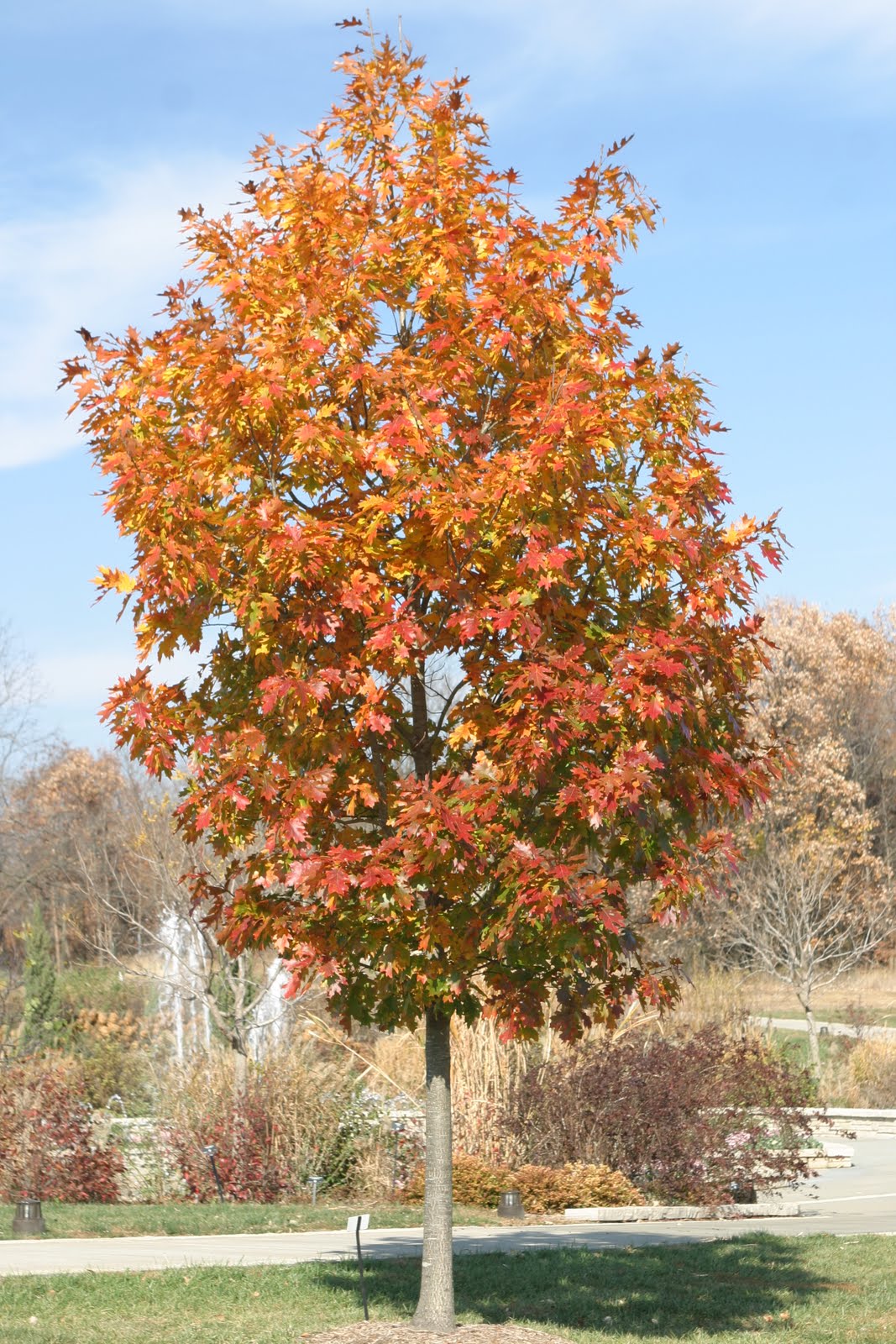
Northern Red Oak (Quercus rubra) decked out in fall attire of bronzy oranges and reds along the walk to the Fountain Garden.

Dwarf Fothergilla (Fothergilla gardenii) is known for some of the best fall colors in a hardy shrub. Here Green Giant Arborvitae provides a nice evergreen backdrop. Look for this scene between the Perennial Garden and Rock & Waterfall Garden.


Pink fall color is rare but is occasional in some viburnums like this self-sown seedling of Missouri Native Southern Arrowwood (Viburnum dentatum) in the Rock & Waterfall Garden.


Flowering Dogwood (Cornus florida) offers some of the best red fall color year after year -- here at the south entrance to the Rock & Waterfall Garden.


Japanese Maples (Acer palmatum) offer some of the most intense red fall colors: almost like they are plugged in! This is foliage of the cultivar 'Emperor I' which is the best of the purple-leaved cultivars for our region as it is slower to leaf out in spring and rarely damaged by late frosts. This small tree is thriving in the shady Rock & Waterfall Garden.


This Zumi Crabapple (Malus x zumi 'Calicarpa') is completely studded with tiny red crabapples. A feast for the eyes in this season and literally a feast for the birds too as their winter larder. Look for these crabapples on the Island Garden.


Plants that stay evergreen are also standouts in this season like this clump of Lily-of-China (Rohdea japonica) in the Rock & Waterfall Garden. Looking like young corn plants, this long-lived perennial stays green all winter. Lily-of-China is a great companion to hostas for some winter interest when they leave the shade garden would otherwise be empty.


The flower beds around the Visitor Center are at peak with cool season, frost tolerant flowers and foliage. This bed contains pansies, lettuce, chrysanthemums, kale and fountain grass left from summer. All these plants hold well until Thanksgiving and often into early December depending on the weather.


The Poinsettia crop in the Powell Gardens' greenhouses is looking as good as ever.


Poinsettias are a difficult crop to grow and need the lengthening nights (without any light pollution -- even light from a street light!) to initiate the beautiful bracts that surround the tiny flowers. This week they will be installed in the conservatory, opening for public viewing on Saturday the 19th. Don't let cabin fever set in and come walk through the late fall gardens and be inspired by late fall's beautiful scenery.