
The Powell Gardens' landscape will near its peak of spring this weekend, the earliest since 1987 from gardener's recollections--certainly the earliest in the 16 springs I have lived here. The Daffodils/Narcissus have been simply spectacular and the early flowering trees have been a breath of fresh springtime colors dancing across the gardens. The Heartland Harvest Garden's peach trees were simply a great joy to witness and we photo documented the entire collection because each variety has flowers that are either showy or not so much. This information is valuable to edible landscapes that want to balance beauty and productivity!
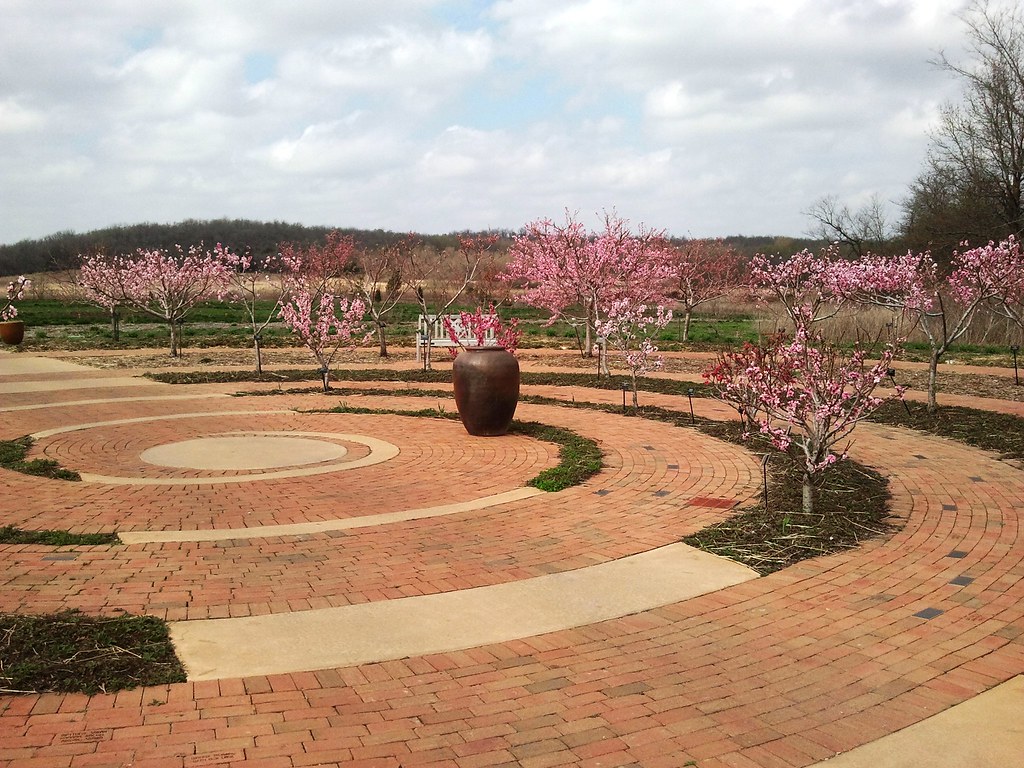
Here is the Peach Court in the Heartland Harvest Garden with its collection of almost 30 varieties of Peaches (Prunus persica and Nectarines var. nectarina). A few of the best cultivars are repeated on different rootstocks, smaller "semi-dwarf" rootstock closer in on the spiral and on "standard" rootstock where they will grow larger to full size on the outer ring of this garden.
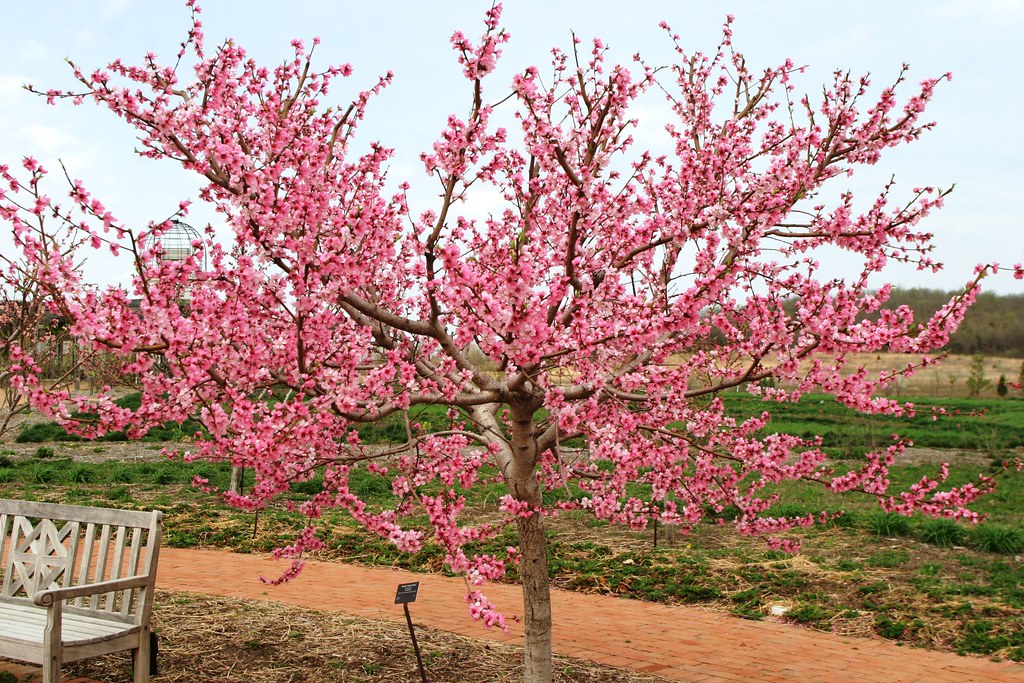
This a Stark 'Saturn' Peach which has some of the showiest, rosy-pink flowers. 17 of the Peach and Nectarine varieties have similar showy, rosy-pink flowers. Saturn Peach is a flat "doughnut" peach from Northern China that does very well in our climate and the peaches are funny looking but delicious!
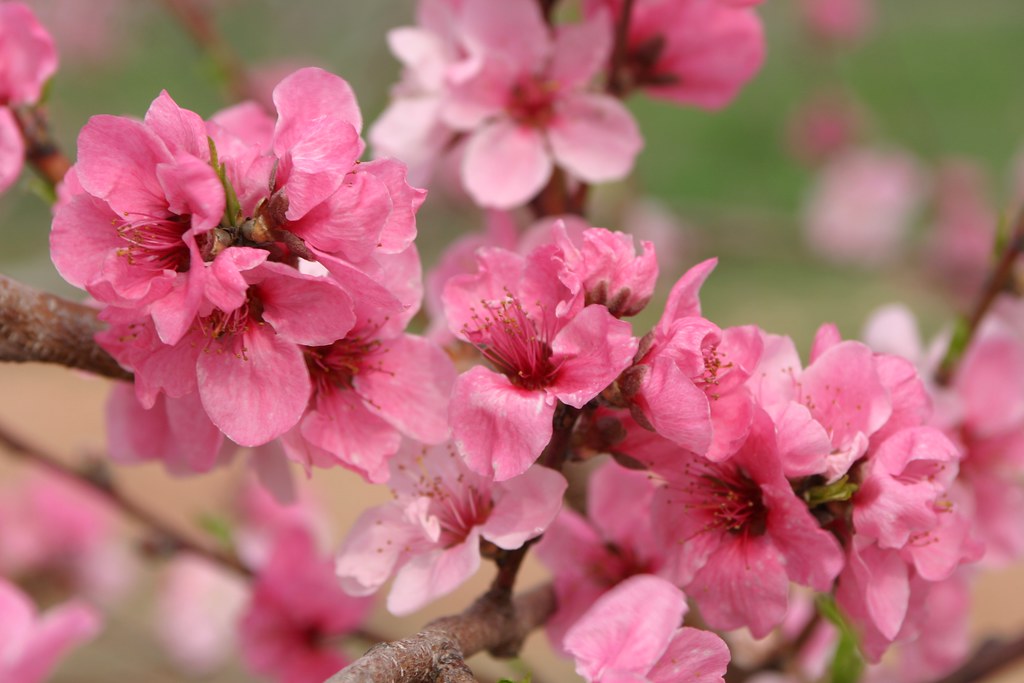
Here's a closeup of a 'Stark CrimsonGold' Nectarine that fits the category of beautiful, showy-flowering peaches and nectarines.
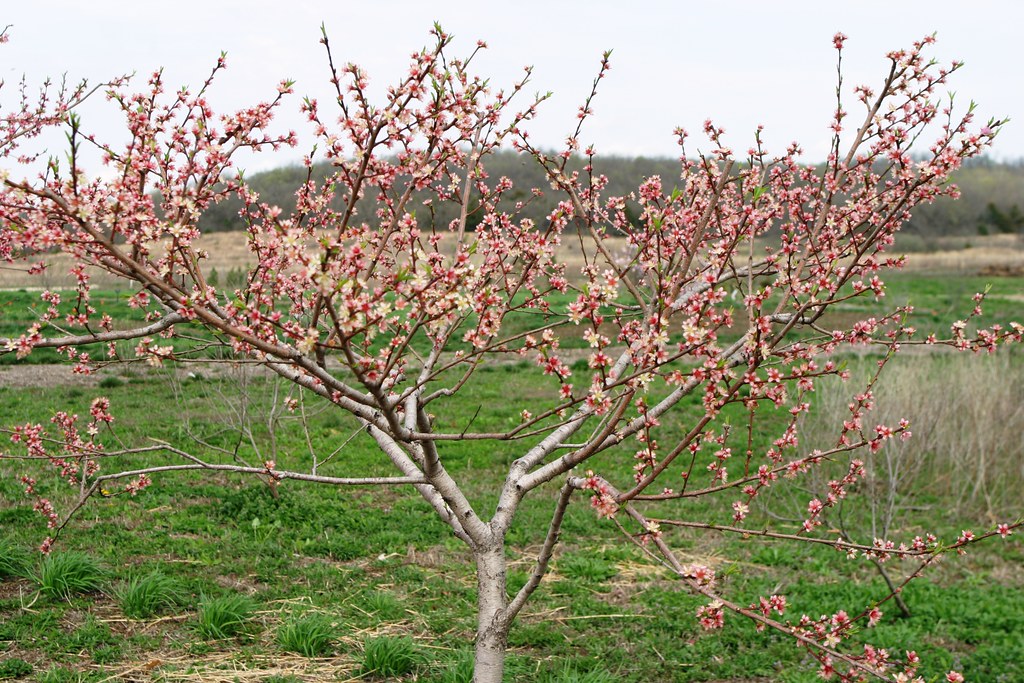
This is the classic Missouri 'Redhaven' Peach which you can see has much smaller, carmine pink flowers that are much less showy in the landscape. We still recommend this variety for its superior peaches but in an edible landscape it looks even better mixed or paired with the showier flowering varieties.

Here's a closeup of 'Reliance' Peach which depicts a variety with less showy, carmine pink flowers. I actually split the less showy varieties into two groups: 11 with less showy carmine pink blooms (which included 'Reliance') and 10 varieties with the least showy carmine pink flowers (which included 'Redhaven' above). Most of the hardiest peaches with both extreme cold and frost tolerance have the less showy type flowers but 'Saturn' is an exception to that rule.

A very few peaches and peach hybrids have beautiful, showy soft pink flowers. This is our "Wilbur Kephart Indian" Peach, which is a family heirloom that was brought from Tennessee where Wilbur's forefathers found it growing wild (Wilbur is an 80-something local farmer, historian and Powell Gardens volunteer). Peaches are actually from China but traveled to Europe on the Silk Road, then via the Spaniards to the New World. The Native Americans quickly adopted the plant and spread it northward into Tennessee where it was already growing by the time settlers arrived. Think of the journeys this plant made!

The "Hardy" Almonds also have this beautiful soft pink bloom. This is the 'Reliable' Almond (Prunus x amygdalo-persica) which gets its hardiness from peaches as it is actually a peach-almond cross. It does produce dry fuzzy fruit with edible almonds in the pits. DO NOT EAT THE PITS OF REGULAR PEACHES as they are poisonous. True Almonds (Prunus dulcis) have white flowers and we have several new varieties hybridized in Russia that are doing well. Look for both 'Reliable' and 'Hall's Hardy' Almonds in our Vineyard.
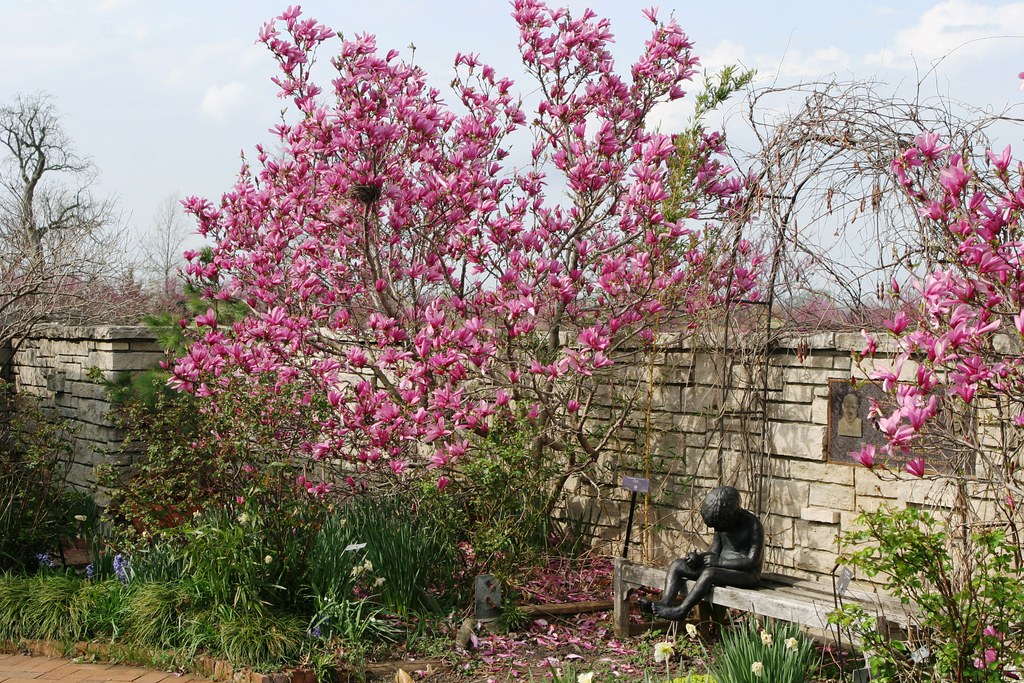
The mid season Magnolias are currently in full bloom throughout the gardens. Here is Ann Magnolia in full bloom in the Courtyard on the north side of the Visitor Center with a sculpture by the late Mary Kay Powell on the bench below the Powell Memorial plaque. Ann is one of the "Little Girl" Magnolias bred at the National Arboretum as hybrid crosses between Star and Lily Magnolias in an effort to get the frost resistance of Star Magnolia and the later bloom of Lily Magnolia. The best ones are named and we have 'Betty,' 'Jane,' 'Pinkie' and 'Randy' in other parts of the garden.
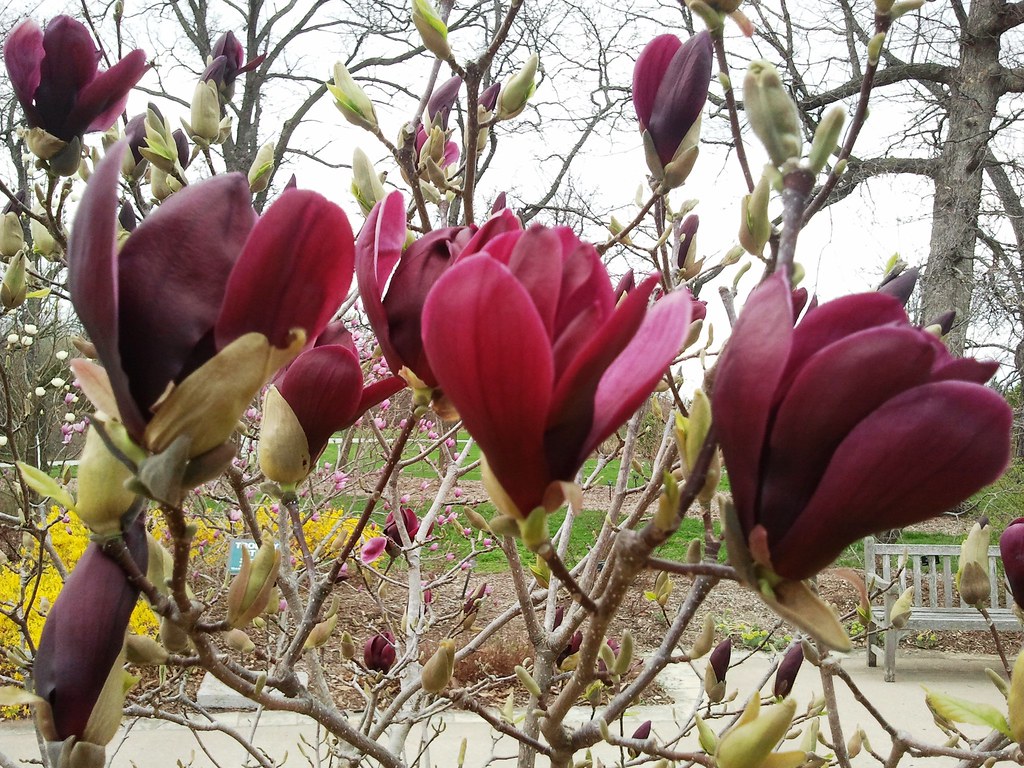
Here are the darkest flowering magnolias currently in bloom at the garden. This is the 'O'Neill' Lily Magnolia (Magnolia liliiflora) growing by the Visitor Center trolley stop. WOW is it vivid this year and seems to be deeper colored the warmer it is. Most varieties are just the opposite and are paler in warmer weather.
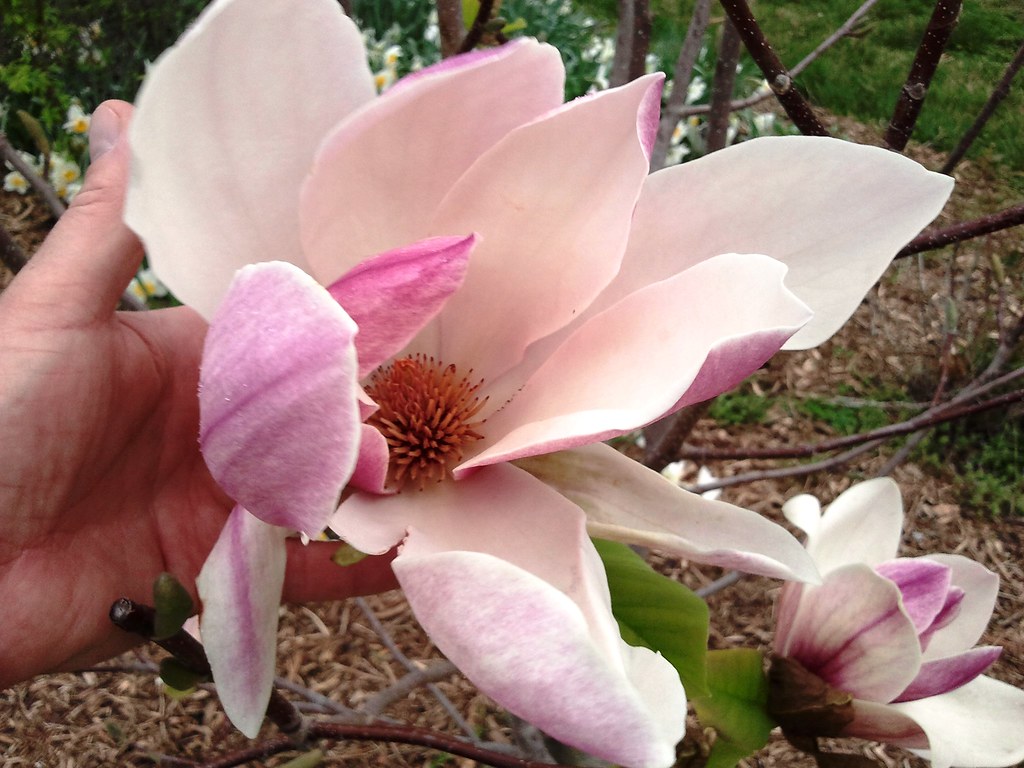
Look at this spectacular Magnolia blossom! This is a new cultivar called 'Toro' and is a hybrid with Missouri native Cucumbertree (Magnolia acuminata). It has HUGE flowers and is very hardy through zone 4. Look for Toro Magnolia blooming on the east edge of the Perennial Garden along the path to the Trigg Building.

Our native woodland wildlfowers are also making their graceful appearance. Linda Williams took this picture of White Trout-lily (Erythronium albidum) during the nature hike on Sunday on the Byron Shutz Nature Trail. Actually the best woodland wildflowers are along the first portion of that trail in the oak-hickory woods and include Spring Beauty, Toad Trillium, and Virginia Bluebells. Our showiest native tree is also going to be in full bloom this weekend: REDBUDS!!! They normally bloom about April 10th here but opened on March 19th out here this year. Come see them and all the other floral surprises of spring now in store for you at Powell Gardens.
Last weekend's tours of the Magnolia collections hit the peak of spring bloom on the early-mid "precocious" (blooming before the leaves) varieties but the mid-season varieties will be in peak flower for this weekend.
Wednesday, March 21, 2012
A Peachy Keen Landscape


Monday, September 12, 2011
Trail Trek on the Byron Shutz Nature Trail
60 hikers participated in our first annual Trail Trek on the 3.25 mile Byron Shutz Nature Trail on Saturday morning. This was part of our first Run Fast, Eat Slow event. I was the "caboose" of the trail trek to make sure everyone found their way and what a glorious experience it was. Here are some images I took along the way (with my camera phone).
The trail head of the lies just north of the Visitor Center just beyond the Fountain Garden. You can see we had a little bug friend admiring the sign.
The bug was a female Walking Stick. It is always a joy to spot and admire this marvelous insect.

Part of the beginning of the trail goes through some rich low woods with tangles of brush and vines. We spotted a very rare butterfly in this rich habitat here during our 9th annual North American Butterfly Society butterfly count on July 30th. It was a Gemmed Satyr butterfly which requires this type of habitat and hasn't been seen in Greater Kansas City since 1950 but its former habitat is now Shawnee Mission Medical Center. The closest other Gemmed Satyrs can currently be found only in Missouri Counties that border with Arkansas.


Here is a closeup of the Bur-Marigolds or Tickseed Sunflowers (Bidens polylepis) though some current botanists lump this and another into Bidens aristosa. This native, annual wildflower graces many roadsides and low meadows at this season.

Here's our bridge over the intermittent stream that bisects Powell Gardens' 970 acre property. The stream flowed all of last year but dried up in the heat of this summer. It is always a peaceful respite with an understory of redbud trees and towering quaking-leaved cottonwood trees above.

Here's one of our prairie restoration areas you will experience further along the trail. We reclaimed almost 20 acres of native prairie remnants through grants from the Missouri Department of Conservation and the US Fish and Wildlife Service. Without management these areas would have also been swallowed up with brush and trees and the unique creatures and wildflowers would have been lost. They are currently at peak flower with classic flowers in gold, white and lavender so typical of the native prairie wildflower palate.

Here's a closeup of one of our unique prairie wildflowers: the Eared False-Foxglove (Aureolaria pedicularia). This wildflower was reviewed as a candidate as a Federal Endangered Species but enough populations were located in the Heartland that it is now listed as a species of special concern. It's a great example of what we would have lost without proper management of our prairie remnants. I had never seen so many plants here before so it is a botanical success story.

Here's a beautiful billow of the Bur-Marigolds again -- they were simply stunning on Saturday! This species does not have the seeds that stick to you like the other members of this Genus (hence the name bur or tick in the name of flowers in this group) -- but Unbur-Marigold or Tickless-Sunflower are even worse names!

The beautiful Rough Blazingstar (Liatris aspera) was in full bloom Saturday too. It is a magnet for migrating Monarch butterflies to nectar on.

Here's a view looking back across the largest area of our prairie restorations. Once upon a time the whole ridge was prairie with just scattered brush and copses of trees. You can see the distant clouds coming in from the north by late morning.

The shrubs with the white berries along the trail are Rough-leaved Dogwood (Cornus drummondii). These are a major food and fuel source for migrating birds as they're very rich in fats. The hot & dry weather this summer lowered the amount of berries produced so birds will have to work a little harder to find food as they migrate. The parched areas south of here in Oklahoma and Texas will be another hazard for migrants on their way back to their winter homes in the tropics of Latin America.

The bright green foliage in this scene are fresh new leaves on the hackberry trees! We had such a super abundance of two butterflies: the Hackberry and Tawny Emperors this year that their caterpillars stripped many hackberries bare. Many of the smaller hackberry trees sent out new leaves this fall.


The clouds over the clay pond was a perfect "Mackerel" sky: a precursor to a coming rain! Yes this type of cloud is named after the fish and I hope you can see the resemblance here.

Many gnarly old Osage Oranges (Maclura pomifera) can be seen along the trail and in some spots you can even see that they are in hedgerows that once were living fences planted on the plains before barbwire was invented.

The prairie remnants long the trail display many wild grasses like these Wild Ryes (Elymus sp.). I haven't yet keyed out which one this is and it may be a natural hybrid between the Canada and Hairy Wild Ryes.

Here's another composition from one of the prairie remnants. Gold goldenrods (Solidago sp.), white Late Boneset (Eupatorium serotinum) and the lavender flowers are our native thistles (Cirsium discolor and C. altissimum)! We remove the invasive "noxious weed" non-native thistles but save the native ones as they are very important nectar plants and their seeds and down are utilized by many birds, especially the goldfinch which times its late nesting to coincide with their bloom.

Here's a look back at the final prairie remnant and you can see the clouds are almost overhead.

Here's a shot from our pine grove with a teenage Loblolly Pine (Pinus taeda) as the focus of the shot. Pines were planted at Powell Gardens when it was a boyscout camp but have naturalized in this area that was formerly an orchard. Our new pine forest is composed of Loblolly, Virginia and Jack Pines -- the farthest north place in the heartland where Loblolly pines have naturalized.

I couldn't resist a shot up into the crown of a large White Ash (Fraxinus americana) next to the trail. You may all know that this tree, with valuable timber and source of the finest baseball bats; is threatened by the escape of the Emerald Ash Borer -- the tree has been destroyed wherever that Chinese bug has invaded. Will we be able to enjoy these magnificent trees here for generations to come?

Just down the path I had to take another tree shot: the crown of a Black Walnut (Juglans nigra). Here's another tree that is abundant at Powell Gardens, THE most valuable timber tree and threatened by a Western disease, the thousand cankers disease, which is moving eastward. It will certainly be a tragedy if these trees are killed in the future and it goes well beyond their $$$ value into the ecological disaster. Many insects are tied to this tree and thus many birds -- it's the favorite host plant (caterpillar food) of our spectacular green-tailed Luna Moths.

Near the end of the trail you cross the northwest corner of a hayfield that was recently baled. A backlit shot but a classic pastoral scene that is part of the trail's experience! We cut the field only after August 1st to ensure the Eastern Meadowlarks and other grassland birds have had time to nest and fledged their young.

Smooth Sumac (Rhus glabra) sports its clusters of red, fuzzy fruit and is already starting to turn the brilliant warm tones it displays for autumn. This is the only woody plant native to all 48 of the lower United States and is very tough. Its fruit is an emergency source of food for birds in winter and it will probably end up an important food source for birds this year. Only female plants produce the berries so those without berries are likely male.

The final hedgerow you pass through at the end of the trail has lots of vines on it: Heart-leaved Ampelopsis or Raccoon-Grape (Ampelopsis cordata). This rampant but native woody vine is a major wildlife plant but is considered too invasive for most gardens. It has gorgeous porcelain violet-blue berries (yes it is the native version of the porcelain vine) but the fruit is not edible like its grape cousins.

The trail used to end in a grove of Scotch Pine (Pinus sylvestris) but pine wilt disease has killed almost all the trees.

We planted many little Green Giant Arborvitae between the pines as we knew the epidemic was coming and we are glad we did. Note the wonderful arborvitaes are nearly 20 feet tall now.

I always stop by the Rock & Waterfall Garden on my way back from the end of the trail. It is such a lush respite during the growing season. The large-leaved tree in this picture is the Missouri native Umbrella Magnolia (Magnolia tripetala) which adds a tropical looking flair to any woodland garden.

Kansas's state flower the Annual Sunflower (Helianthus annuus) graces the meadow (prairie planting) between the Rock & Waterfall and Island Gardens. It is one my favorite and quintessential wildflowers of the season!

A view to the chapel reveals the unique clouds of the disturbed weather that was arriving. It actually didn't rain until late afternoon.

Last stop a look at the Island Garden and its pools filled with gorgeous water plants. The Waterlilies are at their peak of bloom now.
Friday, April 24, 2009
Glorious Redbuds

The extra 10 day wait of this slow spring has been worth it: the redbuds are in full bloom! Most American native, spring flowering trees are white but the Eastern Redbud (Cercis canadensis) defies this color constraint with a shocking raspberry sherbet haze across local landscapes and woodlands. The nectar rich blooms are edible to us and attract a wide array of pollinators and beneficial insects.


Wild and planted Redbuds refresh the scene and paint the woods edge near the Chapel Trolley stop.


