Showing posts with label fall color. Show all posts

Monday, November 14, 2011

Colors of November

The low light of November creates some sublime scenes by intensifying the fall hues. A walk through Powell Gardens offers a prime finale of the fall season.

4p.m. light on the Perennial Garden makes the towering 2o year old Baldcypresses show off their fine fall color to a tee. What better time to sit at the arbor and enjoy the scenery.

Sweetbay Magnolia's (Magnolia virginiana) fall attire of subtle yellows compliments the composition of shrubs beneath it: from purple-red Concorde Barberry (left & background right) to orange Magic Carpet Spirea, glowing yellow Vintage Gold Falsecypress and blue-gray Lavender (right foreground). Look for this scene in the Fountain Garden.

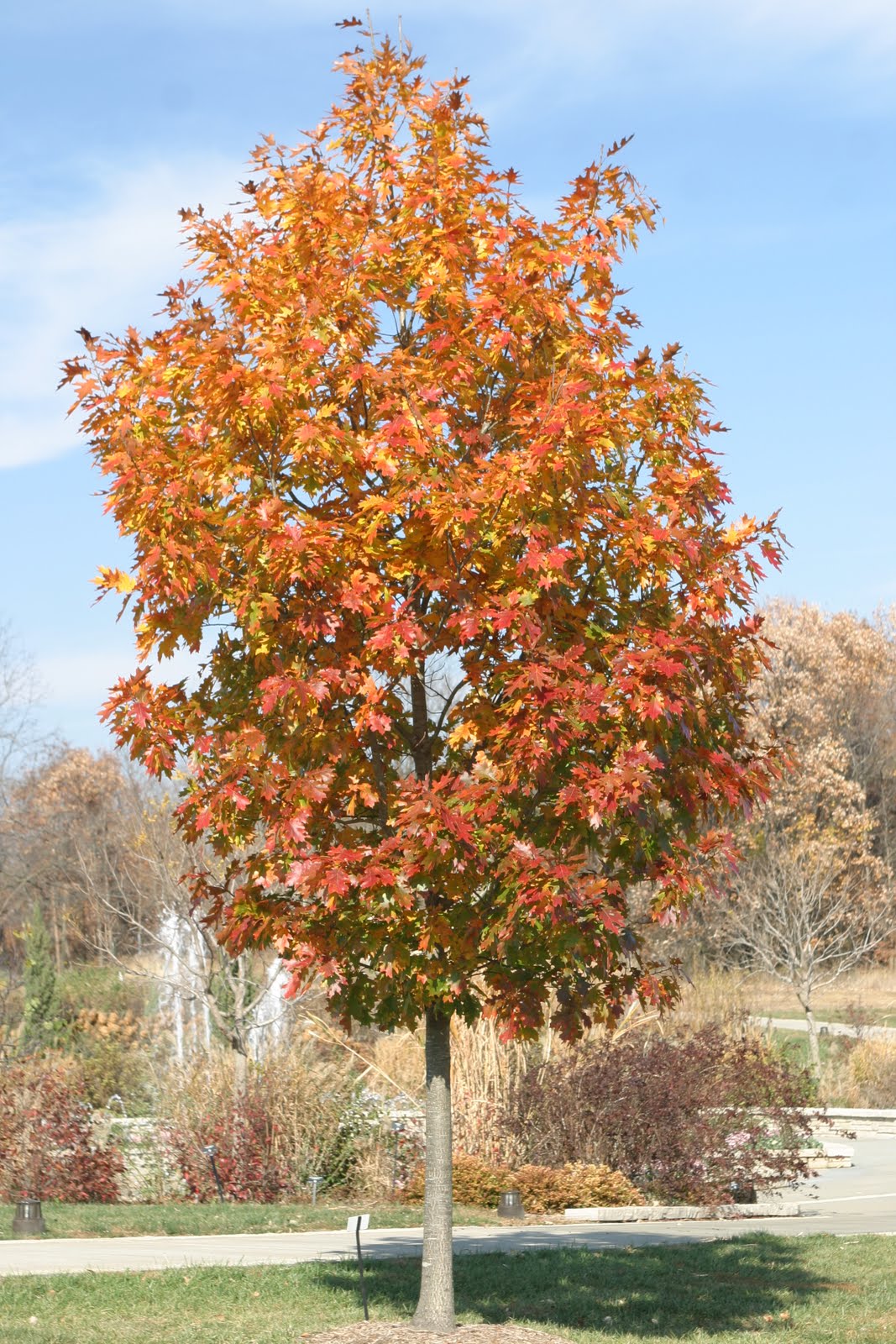
Northern Red Oak (Quercus rubra) decked out in fall attire of bronzy oranges and reds along the walk to the Fountain Garden.

Dwarf Fothergilla (Fothergilla gardenii) is known for some of the best fall colors in a hardy shrub. Here Green Giant Arborvitae provides a nice evergreen backdrop. Look for this scene between the Perennial Garden and Rock & Waterfall Garden.


Pink fall color is rare but is occasional in some viburnums like this self-sown seedling of Missouri Native Southern Arrowwood (Viburnum dentatum) in the Rock & Waterfall Garden.


Flowering Dogwood (Cornus florida) offers some of the best red fall color year after year -- here at the south entrance to the Rock & Waterfall Garden.


Japanese Maples (Acer palmatum) offer some of the most intense red fall colors: almost like they are plugged in! This is foliage of the cultivar 'Emperor I' which is the best of the purple-leaved cultivars for our region as it is slower to leaf out in spring and rarely damaged by late frosts. This small tree is thriving in the shady Rock & Waterfall Garden.


This Zumi Crabapple (Malus x zumi 'Calicarpa') is completely studded with tiny red crabapples. A feast for the eyes in this season and literally a feast for the birds too as their winter larder. Look for these crabapples on the Island Garden.


Plants that stay evergreen are also standouts in this season like this clump of Lily-of-China (Rohdea japonica) in the Rock & Waterfall Garden. Looking like young corn plants, this long-lived perennial stays green all winter. Lily-of-China is a great companion to hostas for some winter interest when they leave the shade garden would otherwise be empty.


The flower beds around the Visitor Center are at peak with cool season, frost tolerant flowers and foliage. This bed contains pansies, lettuce, chrysanthemums, kale and fountain grass left from summer. All these plants hold well until Thanksgiving and often into early December depending on the weather.


The Poinsettia crop in the Powell Gardens' greenhouses is looking as good as ever.


Poinsettias are a difficult crop to grow and need the lengthening nights (without any light pollution -- even light from a street light!) to initiate the beautiful bracts that surround the tiny flowers. This week they will be installed in the conservatory, opening for public viewing on Saturday the 19th. Don't let cabin fever set in and come walk through the late fall gardens and be inspired by late fall's beautiful scenery.


Thursday, October 14, 2010

Autumn Visions in the Garden

Mid Autumn is already here and the weather has been simply spectacular. The colors of the season are starting to charm the visitor and speak to the spirit of this Midwestern Garden.

A Cherokee Sunset Flowering Dogwood (Cornus florida) shade a patch of vibrant impatiens for some striking color combinations. Look for this composition near the Hummingbird Garden outside the Visitor Center.

Purple Dahlia Zinnia (Zinnia elegans) continues to thrive and bloom in the Hummingbird Garden even though our hummingbirds have all migrated southward. This is one of two seed strain Zinnias we love for nectaring butterflies and hummingbirds as well as for disease resistant foliage. Most zinnias would be rubble mired in mildew after this past wet season.


Mexican Sunflowers (Tithonia rotundifolia) continue to sport their velvety orange blossoms so apropos for the season. I like the background of burgundy Flowering Dogwood fall foliage in this shot from the Hummingbird Garden.
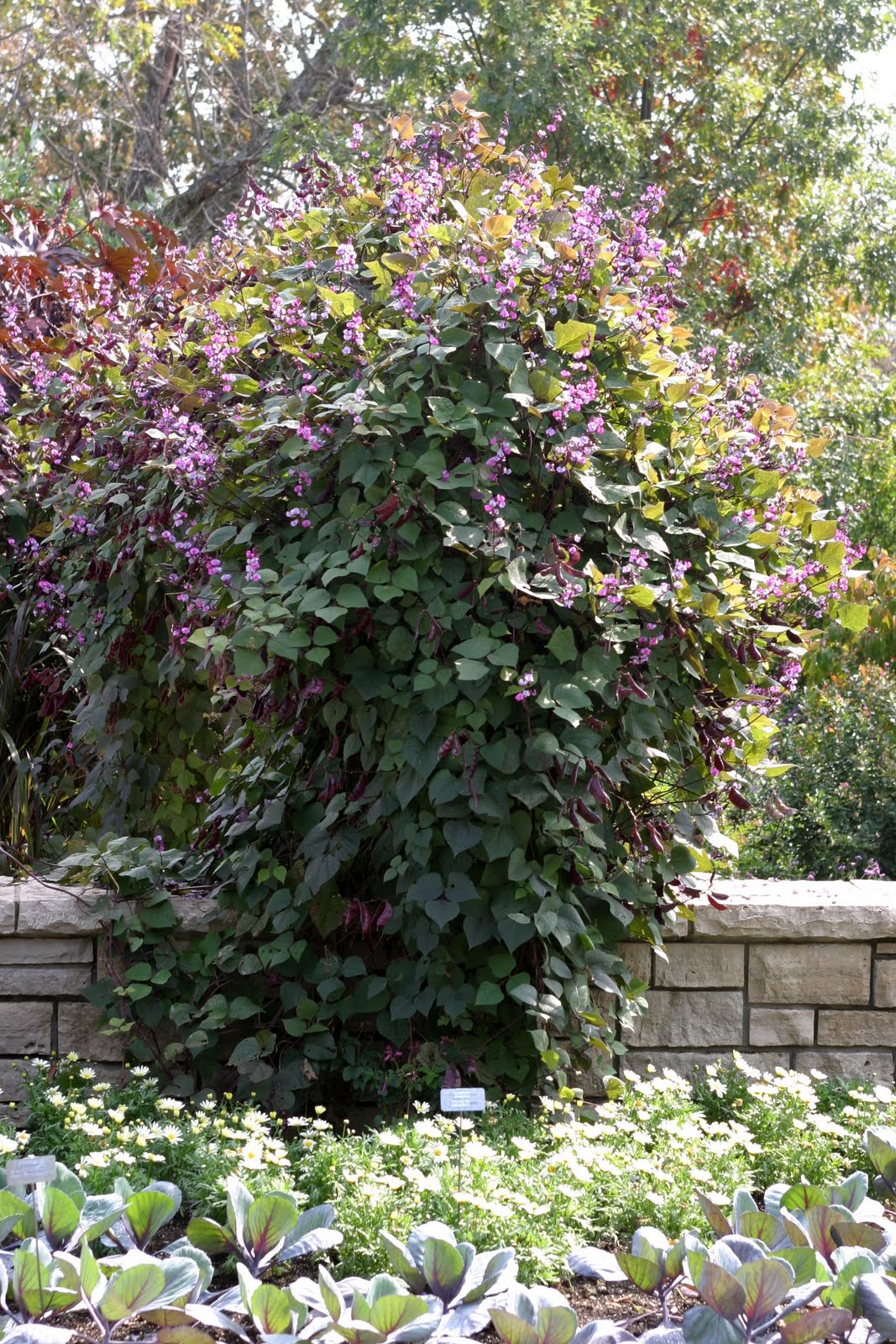
As long as Jack Frost stays away, our overhead arbor of Purple Hyacinth Bean (Dolichos lablab) in flower and fruit will greet visitors on their way from the Visitor Center to the Dogwood Walk.

A walk down the Dogwood Walk to the Island Garden is well worth the exercise! The views from the Island Garden to the chapel are stunning when framed by Maximillian's Sunflower and prairie grasses at the peak of their fall colors.

The Aromatic Asters (Aster oblongifolius) in the Island Garden's living wall's eastern end are awash in bloom. Make sure to look at all the butterflies and beneficial insects visiting the flowers as you walk past.

The meadow is in full autumn attire with blooming asters (New England Aster Aster novae-angliae depicted) with various seedheads (Illinois Bundle Flower Desmodium illinoiense) and grass seed heads (Giant Foxtail Setaria italica) set off by billowing masses of local prairie grasses.

Many of our oak trees are just starting to turn colors like this stalwart Post Oak (Quercus stellata) growing on the edge of the Rock & Waterfall Garden. This is one of our toughest native trees and should be planted more often but doesn't conform to nursery production. It is a tree that withstands everything that Mother Nature can throw at it from heavy ice load to extreme heat and drought.

Shagbark Hickories (Carya ovata) are also turning shades of yellow and are another tried and true native tree here. They also don't conform to nursery production so are never available for homeowners to plant. Look for many of these trees with classic shaggy bark in the Rock and Waterfall Garden.

The Pawpaws (Asimina triloba) are also turning their characteristic shades of pale yellow in the understory of the Rock & Waterfall Garden. This tree is becoming more popular in gardens as edible landscaping themes gain mainstream acceptance. If you've never eaten a pawpaw fruit before, be sure and visit Powell Gardens next early to mid-September next year to sample a pawpaw at the tasting stations in the Heartland Harvest Garden.

Grasses are a mainstay of local autumn gardens and here huge 'Guilded Tower' Giant Miscanthus (Miscanthus x giganteus) stands left of lovely 'Autumn Red' Miscanthus (Miscanthus sinensis) near the Perennial Garden trolley stop. Note the heavily fruited 'Centurion' Crabapple in the background which adds to the autumn colors of this composition.

Tall Tails Fountain Grass (Pennisetum orientale) always is a fun blast of seedheads in this season. Look for this mass with complimentary crabapple and chrysanthemums also near the Perennial Garden trolley stop.

'Hameln' Fountain Grass (Pennisetum alopecuroides) also acquires some nice fall hues and looks great with various chrysanthemums in the Perennial Garden.

Many shrubs throughout the gardens are studded in autumn fruit. This is a rare cultivar of Missouri native Southern Arrowwood (Viburnum dentatum) called 'Firework' because the stems of the blue berries are bright red.

Another Viburnum with striking fruit now is the Linden Viburnum (Viburnum dilatatum): this is the heavy fruiting cultivar 'Asian Beauty.'
The weekend is supposed to continue our spectacular streak of gorgeous fall weather so be sure and consider a visit to Powell Gardens and experience its gorgeous autumn visions.


Tuesday, October 27, 2009

Peak Fall Color 2009!

Fall colors have been "the best ever" as described by gardeners and locals alike. We attribute this to a wonderful growing season with only a small dry spell in September followed by unprecedented cool weather and over 6 inches of rain already in October at the Powell Gardens' weather station.


Here's an overview of the fall attire of the Powell Landscape. Prairie grasses tawny and oak-hickory woods in russets and browns while the baldcypress (right side of image) is already its classic rust -- not coloring up before November here in more than 10 years.


Powell Gardens does not have many maples but this 'Red Sunset' Red Maple (Acer rubrum) east of the Visitor Center was blazing red. This tree is over planted in Kansas City but its fall color explains why. All maples have dense surface roots making them difficult to garden (or grow lawn) under.


Osage-Oranges (Maclura pomifera) show good yellow fall color this year and this female tree east of the Visitor Center has dropped a nice collection of her chartreuse green "hedge ball" fruit. The tree is simply called "Hedge" by the locals. If you hike the Powell Gardens nature trail you will experience wonderful old hedgerows of this tree. If your tree has never born fruit, it is most likely a MALE tree.


Dogwoods are Powell Gardens' finest trees for fall color and the colorful tree in this picture is the hybrid cultivar 'Ruth Ellen' (Cornus x rutgersensis) Look for all types of dogwoods along the "Dogwood Walk" between the Visitor Center and the Island Garden.


Flowering Dogwoods (Cornus florida) are studded with bright red berries though robins have been busy gobbling them up to fuel their southward migration.


Oriental Kousa Dogwoods (Cornus kousa) grace the lower part of the dogwood walk and display some of the finest blends of warm colors now.


Hillside Sheffield Pink Mum (Chrysanthemum coreanum hybrid 'Single Apricot') foreground sets the stage for the bridge to the Island Garden with a rusty fall Baldcypress in the background.


There are still lots of flowers in the gardens because there has been no severe freeze yet. Champlain Rose, one of our favorite red landscape roses is a hybrid from the Morden Experiment Station in Manitoba, Canada. All of the "Morden" roses are some of the best performing roses at Powell Gardens.


The Conifer Garden at the north end of the Visitor Center looks at its best now while the tapestry of groundcover sedums are in fall color. The glowing yellow-needled Chief Joseph Pine (Pinus contorta) is a beacon of yellow in the fall and winter landscape -- it turns green in the summer.


A closeup of the Conifer Gardens' tapestry of sedums show coral fall colored 'Weinstephaner Gold', red 'Voodoo' and yellow-green 'Angelina' Sedums.


Barbara Fetchenhier, Gardener in the Heartland Harvest Garden stands next to our Flying Dragon Hardy Orange (Poncirus trifoliata). You can see a few small "oranges" on the tree (mainly lower left). This hardy citrus has musky-lemon scented fruit that can be made into a "Kansas City Orange Pie" according to our former Gardener Chris Conatser who now works at culinarily renowned Justus Drugstore in Smithville. More on this unique shrub / small tree in a future blog.


Asian Pears (Pyrus pyrifolia 'New Century') have turned some nice shades of yellow in the Heartland Harvest Garden. Who says edible plants aren't ornamental!


My favorite fall tree in the Heartland Harvest Garden remains the Nikita's Gift Persimmon from the Ukraine. A hybrid between our wild persimmon and the unhardy Oriental one in the grocery store, it combines the attributes of both and is simply gorgeous on the tree in late fall. It's delicious when tomato red ripe too!


While exploring the Heartland Harvest Garden seek out the Medlars (Mespilus germanica) in the Missouri Star Orchard. This weird fruit related to our hawthorns is only edible after it has fallen and rotted a bit -- then it has a apple sauce-like flavor.


Wow, another vivacious fall flower: Alpha Calendula (Calendula officinalis) can be seen in the Heartland Harvest Garden's Kitchen Garden south of the barn (it's an edible flower!). All of the fall seasonal flowers are planted out in the Heartland Harvest Garden and around the Visitor Center. YES there are many wonderful cool-loving, frost tolerant flowers for local gardens that easily last through Thanksgiving.

A fall-blooming species crocus got mixed in with a purchase of saffron crocus bulbs.

We planted 1,000 Saffron Crocus (Crocus sativus) in the Kitchen Garden's "tapestry of thyme" -- and a couple did bloom this fall but most should not bloom until the following fall. The beautiful red-orange stigmas in the center of the flower are what true saffron is made of: the most expensive spice in the world. Matt Bunch describes the flavor as "sweet buttery green tea." Spice up YOUR life with a visit to Powell Gardens in full fall attire!

Wednesday, October 21, 2009

Powell Gardens is Splashed with Autumn Color

Last week's unprecedented cool days and wonderfully mild cool nights have set the stage for a fine fall foliage event. In our Rock & Waterfall (shade) Garden the fall colors are as good as ever. I expect peak fall color out here at Powell Gardens this weekend, one week earlier than "average."

Weeping Threadleaf Japanese Maple (Acer palmatum dissectum group 'Viridis') has fall color that appears on fire in the shaded understory of the Rock & Waterfall Garden. The finely cut leaves add a very fine texture in contrast to larger coarser leaves of wild oaks.

The Redwing cultivar of American Highbush Cranberry (Viburnum trilobum 'Redwing') reveals a very complex range of colors that is quite wonderful. This shrub is native in the Great Lakes States and northeast and prefers a cool, afternoon shaded environment here. This plant is in full shade so did not flower or produce its classic red fruit for the winter landscape, but its foliage has been exceptional all season.


A different cultivar of Threadleaf Japanese Maple 'Emerald Green' shows orange fall color. Again, the delicately dissected leaves add a very fine texture, even finer than ferns in the foreground.


This small tree is a fun challenge on identification. The leaves look like an elm or hornbeam but they are opposite each other on the twig. This is actually a maple species from Japan! Hornbeam Maple (Acer carpinifolium) reliably turns nice yellow hues in fall in a shaded understory environment as seen here in the Rock & Waterfall Garden.


The Rock & Waterfall Garden is known for its azaleas and hybridizers have created a new series that rebloom well into fall! These azaleas are known as Encore (registered trademark) Azaleas and this is the cultivar 'Autumn Royalty.' These azaleas are listed as hardy only through zone 7 but they have done well in sheltered locations in the recent mild winters. This shrub was donated to us by Leah Berg -- she also hosted a recent program with Fox 4's meteorologist Don Harman. Don showed us that statistics document the average winter temperature for Greater Kansas City has increased by 6 degrees F over the past 30 years.

One of my favorite shrubs Oakleaf Hydrangea (Hydrangea quercifolia) reveals a very complex pattern of fall colors emerging on its leaves when grown in sun. There are two or more weeks of good fall color on this shrub as long as temperature don't plummet too low.


The Winterthur (pronounced winter-ter) cultivar of Witherod Viburnum (Viburnum nudum) has spectacular fall color -- starting out purple then turning this bronzy red as the green chlorophyll is withdrawn from the leaves. The leaves are also glossy which adds to this color display and here at the entrance to bridge to the Island Garden, it is masterfully combined with a bronzy-orange Andrea mum.

The Island Garden's Senior Gardener Mark Gawron planted this Mum (Chrysanthemum x morifolium 'Andrea' -- not accessioned because we didn't expect it to return) for seasonal color in the fall of 2006 and it has weathered 2 winters now and is a most masterful combination with the Winterthur Viburnum in a area whose color scheme is orange, burgundy and pink.

Female cultivars of American Bittersweet (Celastrus scandens) grace the railings of the bridge to the Island Garden and are in fall color and full fruit display. A male and female vine are needed together to set fruit. For those who want just ONE bittersweet I am happy to let you know a new cultivar that is self-fruitful in now available! Look for the Bittersweet 'First Editions (registered trademark) Autumn Revolution (trademarked)' at local nurseries that carry Bailey Nursery plants.


'Tis the season for one of my favorite perennials: Hillside Sheffield Pink Mum (Chrysanthemum coreanum hybrid 'Single Apricot') Each late fall I thrill at the magnificent floral display of this reliably hardy mum (now blooming for the 9th straight year at this location on the Island Garden). Anyone with a butterfly garden should include this plant as it is the favorite last nectar source of many butterflies and beneficial insects.


The Living Wall on the Island Garden still has stunning compositions of plants: here blue-flowering 'Walkers Low' Catmint (Nepeta x faassenii) is underplanted with stunning Furman's Red Autumn Sage (Salvia greggii). Both these are very reliable perennials (since the garden's opening in April 2001 -- and bloom from as early as April to as late as December!).


We have a very good collection of Lavenders and the cultivar in the center of this picture is the most silvery of them all: 'Silver Frost.' Silver Frost Lavender (Lavandula hybrid) outshines all others, contrasting nicely with Ballota (ba-LO-ta) on the Living Wall. Oakleaf Hydrangea in fall attire is the purple foliage above while Furman's Red Autumn Sage is the red flowers in the background.


For those who love lavenders, Buena Vista Lavender (Lavandula angustifolia) is the only cultivar we have that reliably reblooms. Senior Gardener Mark Gawron just deadheads it once and it completely reblooms like no other cultivar. We are propagating our plants for Powell Gardens Spring Plant Sale the first weekend in May 2010.


This delightfully blue, fall-blooming perennial is the Texas Grass Sage (Salvia reptans). Many of our wonderful Living Wall perennials originally came from High Country Gardens in Santa Fe, NM http://www.highcountrygardens.com/.


The diminutive but delightful fall blooming onion Allium thunbergii 'Ozawa' is in peak bloom with accompanying honey bees. This little perennial grows just above the living wall between golden Angelina Sedum and silvery Valerie Finnis sage -- the label in the background is 3" X 5" to give you a sense of scale.

Gorgeous Waterlily Colchicums are still exploding through Hardy Plumbago (Ceratostigma plumbaginoides) groundcover that has now turned into its fall color of burgundy. I always recommend planting small bulbs with this groundcover as it is slow to emerge in spring. Colchicums have luscious leaves in the spring that the plumbago overtakes as they go dormant in late spring, the naked blooms pierce through the plumbago in fall for a stunning combination.
All photographs were taken by Alan Branhagen on Tuesday, October 20, 2009 at Powell Gardens. Please come out and experience this glorious fall!