
Jack Frost's cousin Mr. Deep Freeze hit the gardens Sunday night -- we had a low of 20F at Powell Gardens (22F in the city at the Kauffman Memorial Garden) that ended the season for many of our fall flowers. Pansies, Violas, ornamental cabbages and kale weathered that well and fruiting plants are just as beautiful as ever so there is still a lot of beauty to see in the gardens.

Deciduous Hollies or Possumhaws (Ilex decidua) are now leafless but the female trees are simply ablaze with red holly berries. What a warming element to the late fall (and winter) landscape -- a wonderful display of these can be seen along the gatehouse landscape when you enter Powell Gardens.

Flowering Crabapple varieties that produce fruit are simply stunning now too. This is the 'Donald Wyman' Crabapple in the Perennial Garden simply loaded with small red crabapples right now. Some would argue that these fruit are messy but the varieties we display at Powell Gardens hang on to their fruit until the birds eat them. There is minimal mess, an easy price to pay for such an ornamental display that lasts for weeks and even months depending on the weather. Donald Wyman Crabapple has fleeting red-budded, white flowers in spring but a much more spectacular display of red crabapples in fall and winter.
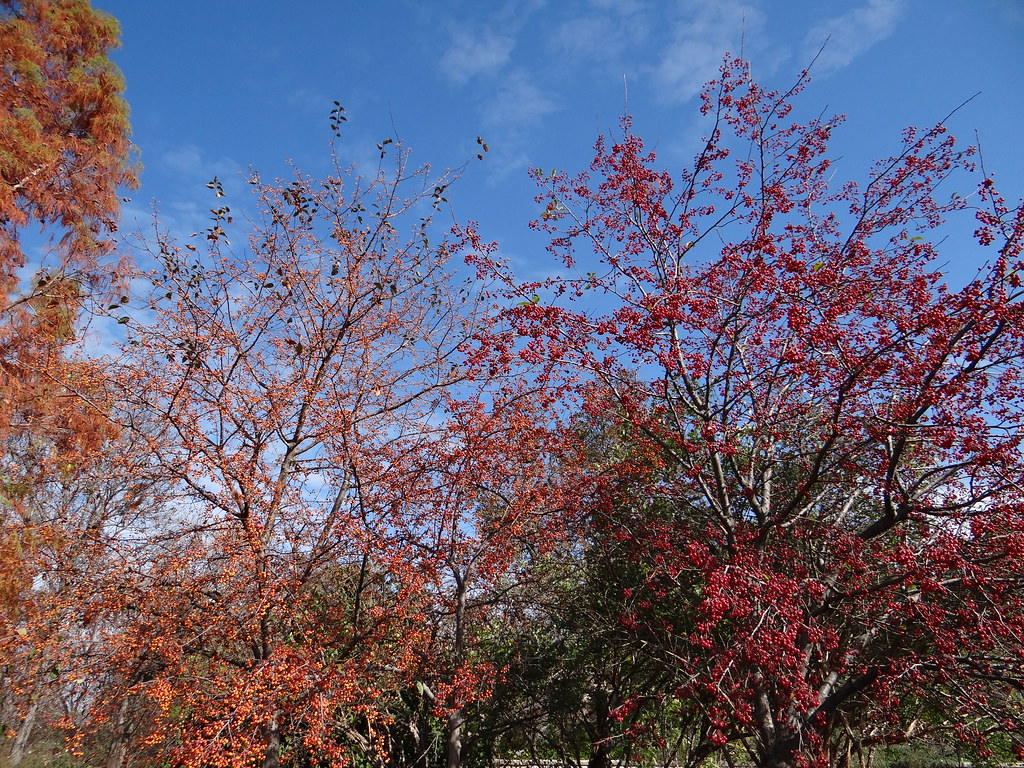
Here's another view of the Donald Wyman Crabapple (right) showing its neighbor the 'American Masterpiece' Crabapple (left). There are several varieties of crabapples with more orange fruit like 'Amercan Masterpiece' which unfortunately is no longer available. American Masterpiece has cranberry red flowers in spring and almost pumpkin orange little crabapples in fall and winter.
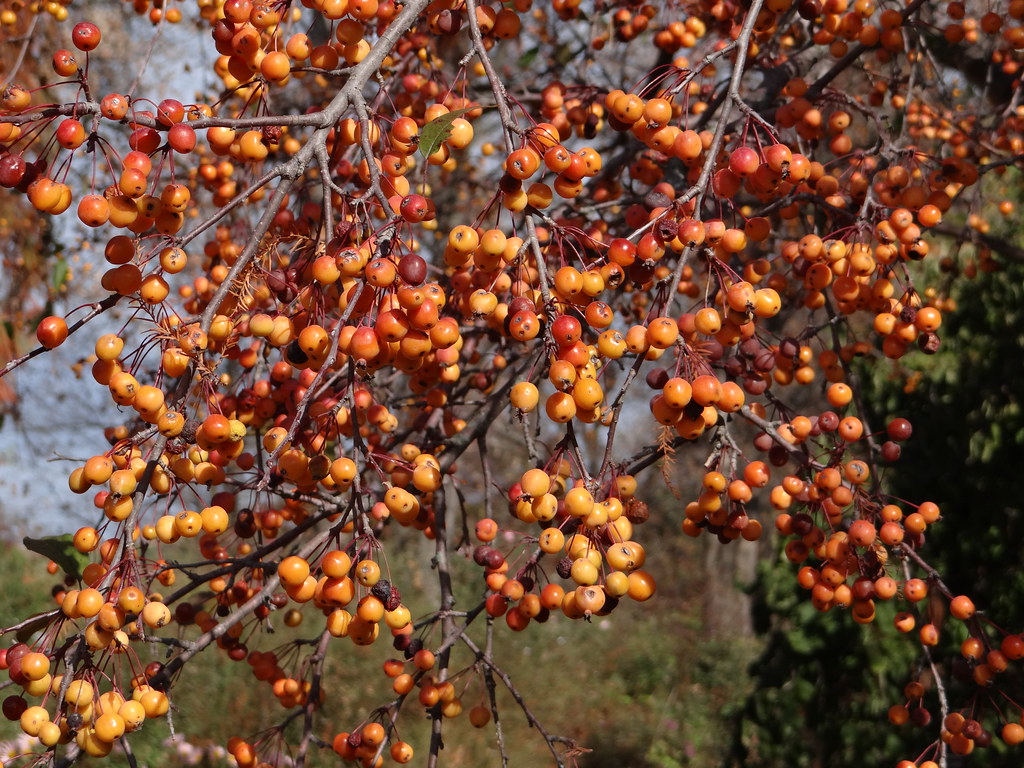
Here are the orange crabapples of 'Indian Magic' Crabapple which is widely available. It's a smaller tree with purplish-red flowers in spring. Our tree of this is wedged between the much more vigorous Donald Wyman and American Masterpiece Crabapples in the prior image.
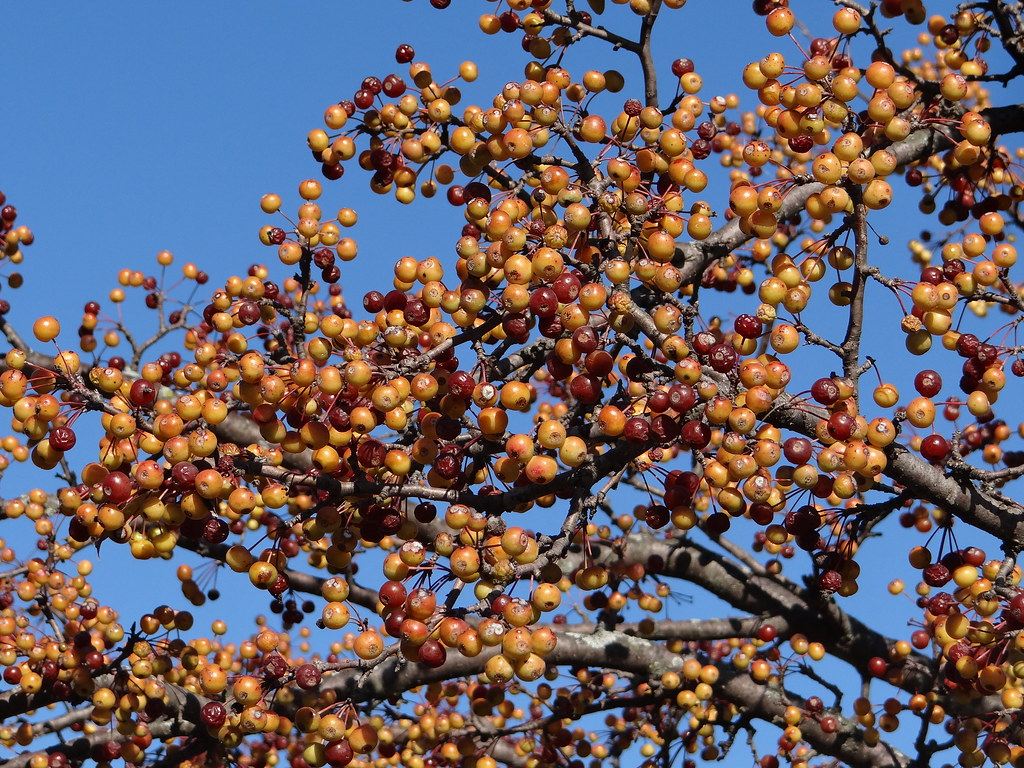
Tea Crabapples (Malus hupehensis) are bronzy orange now too, as they age you can see some are turning redder. These trees have a beautiful vase shape but grow quite large over time. Look for these at the west (Visitor Center) entrance to the Island Garden.
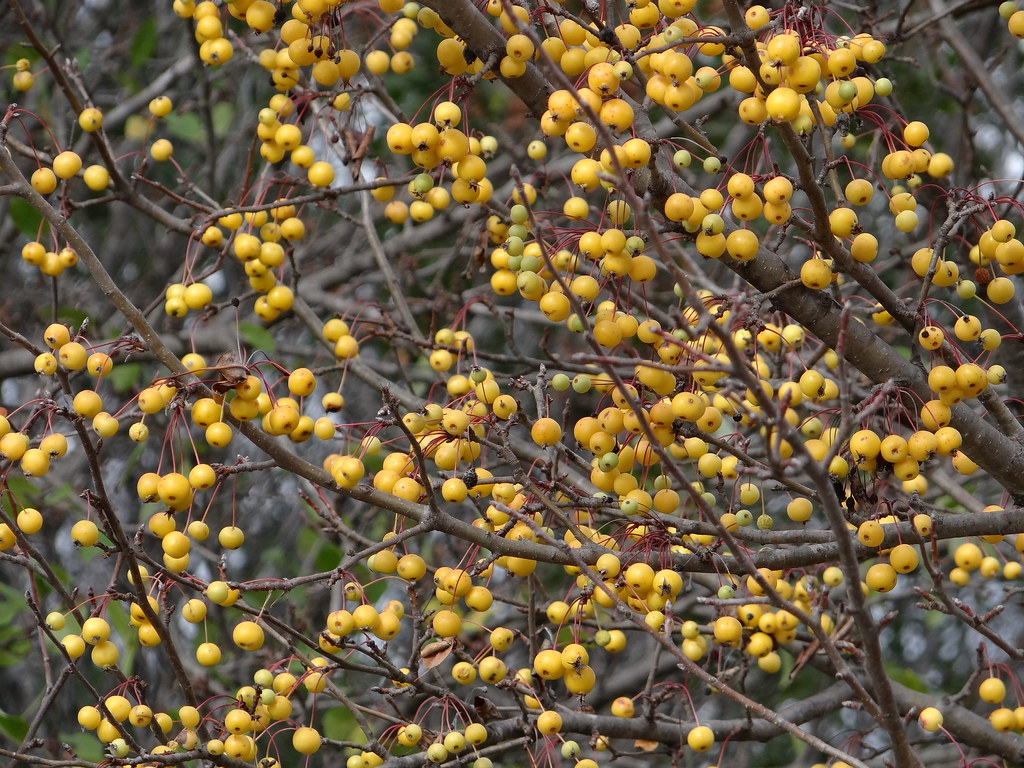
Yes, crabapples come in yellow too! Here are 'Harvest Gold' crabapples which are such a warm yellow at this season. Their spring flowers are red-budded opening to white, fragrant flowers. Night lighting is reflected beautifully from these too. The color of the yellow crabapples holds until eaten by birds or a severe freeze (colder than 10F) makes them turn bronze. Look for Harvest Gold Crabapples on the east (Meadow) side of the Island Garden.
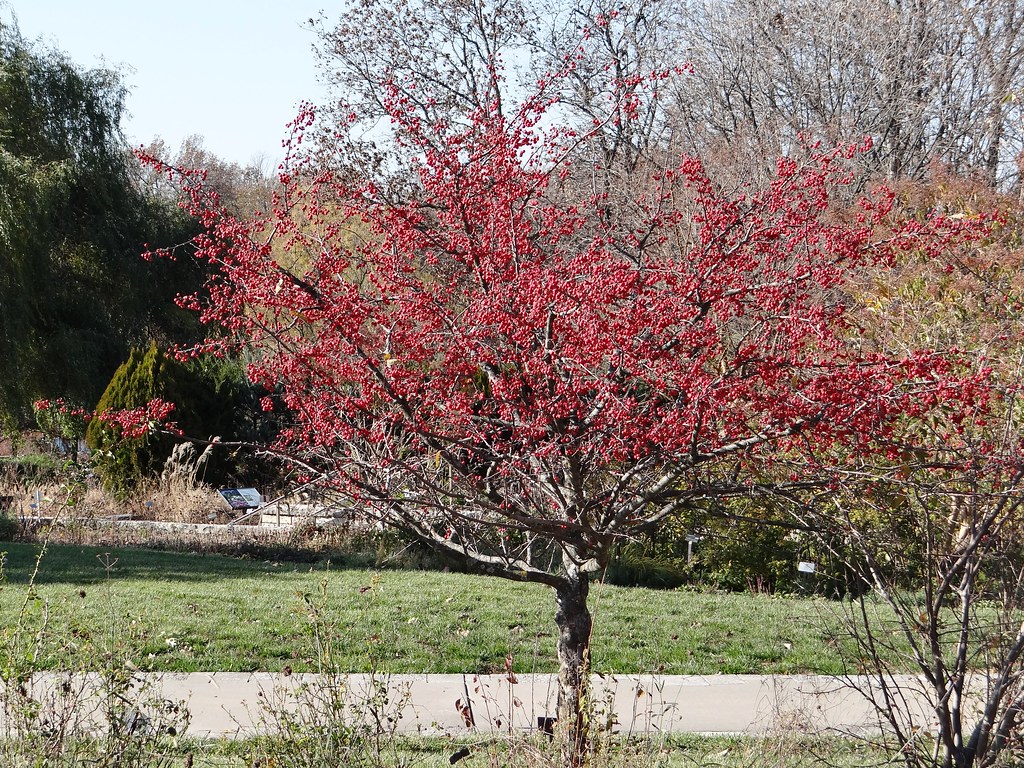
Here's a 'Sugar Tyme' crabapple on the edge of the Perennial Garden. It has very nice fruit set too and stays a smaller tree -- what most nurseries are going for now. When selecting a crabapple I always start with learning if it is a disease resistant variety (all described above are very disease resistant here). Secondly I look at its mature size (most grow taller than wide). Thirdly I pick them for their fruit display and I pick them last for their flowers! Ornamental crabapples are phenomenal plants for wildlife friendly gardens. Their fruit is a staple of many fall and winter birds. They are also host to many beneficial insects and unlike most non-native plants, our native insects readily transfer from our disease-prone native crabapples to these more garden ornamental varieties. Crabapples are also NOT invasive like ornamental pear trees in our region.
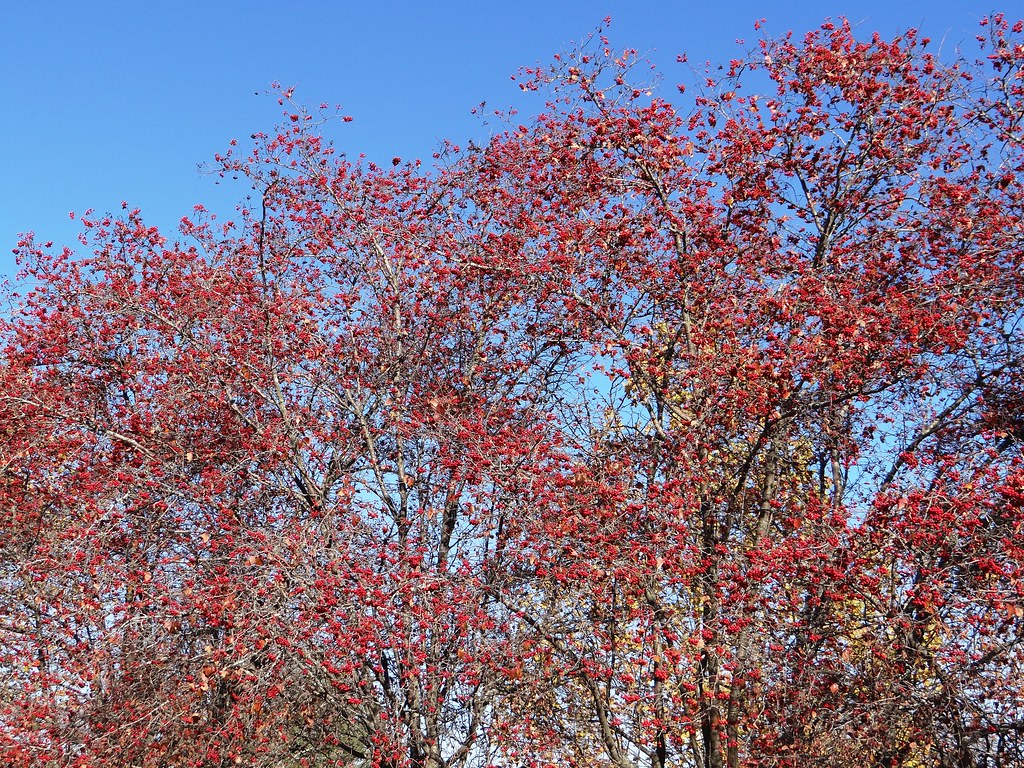
The Washington Hawthorns (Crateagus phaenopyrum) are also beautiful at Powell Gardens right now as the leafless trees are completely cloaked in red fruit. The dry year helped them out as they can be very disfigured by cedar-quince rust disease -- a reason we no longer recommend them. Look for them by our trial beds near the old visitor center. Hawthorns are a beautiful and important part of our native flora so we do have them in the wilder parts of the garden including 3 native species along the Nature Trail: Frosted Hawthorn (Crataegus pruinosa), Red or Downy Hawthorn (C. mollis) and Cockspur Hawthorn (C. crus-gallii).
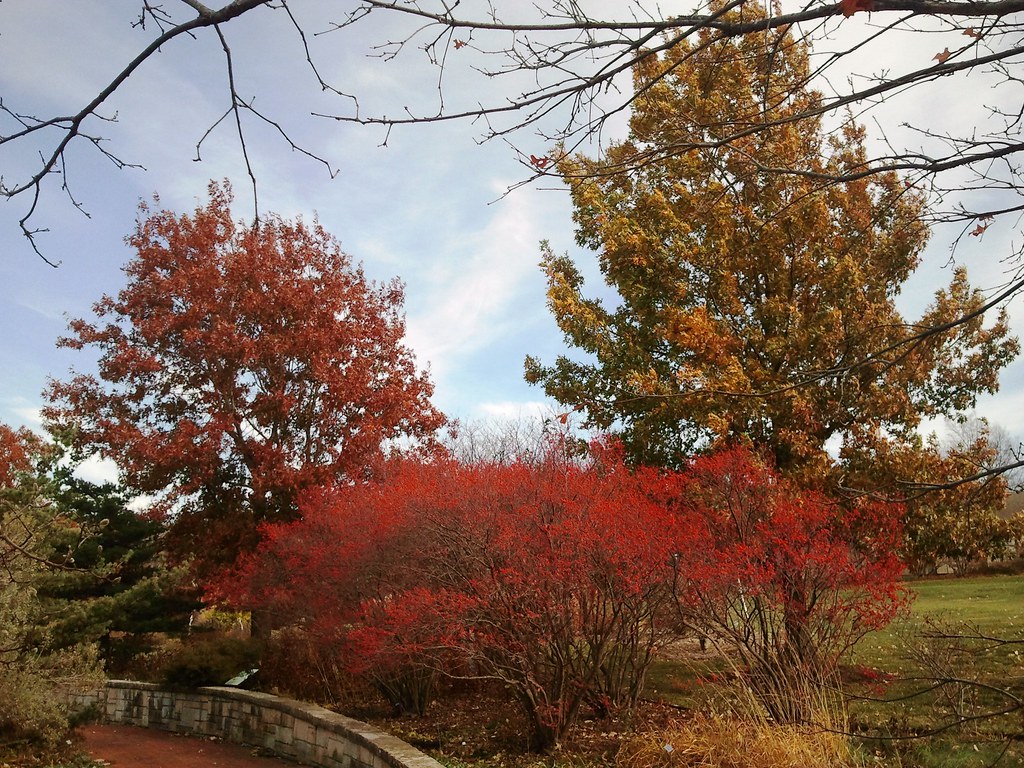
The blazing red shrubs in the above image are 'Sparkleberry' Hollies (Ilex serrata) in fruit in the Perennial Garden. Behind them are Shumard Oaks (Quercus shumardii) which are very late in their fall color -- some Shumard Oaks usually have no fall color while others can be a nice red. So there is still much beauty in the late fall garden, most specifically the brilliant fruit of fall-fruiting plants.
Thursday, November 15, 2012
Berried Trees Enliven the Late Fall Landscape


Thursday, March 29, 2012
Reflecting on Redbuds
The native Eastern Redbuds (Cercis canadensis) began blooming at Powell Gardens on March 19, 2012 and have held well through March 28th and into today. They usually begin peak bloom around April 10th at Powell Gardens so this was an early event this year and it has been spectacular! Redbuds reflect our spirit of place better than any other flowering tree as they are native to our site. Redbuds in flower hold well in our edge of the Great Plains location being wind and frost resistant as well as lasting for at least 10 days even in warm weather -- way longer than any crabapple, serviceberry and most other flowering trees.
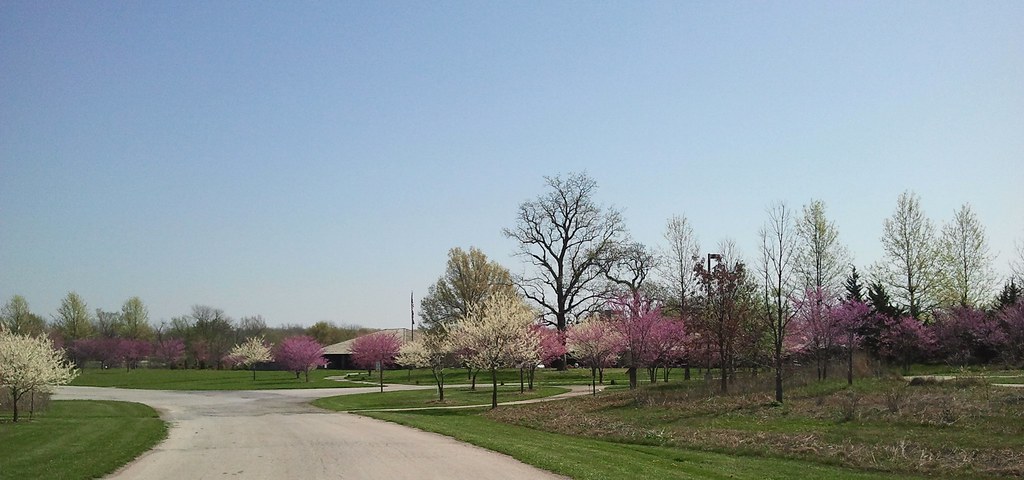
Here's a panorama looking towards the Visitor Center from the road between the parking lots. The redbuds and whitebuds (Cercis canadensis 'Alba') are really putting on a show!
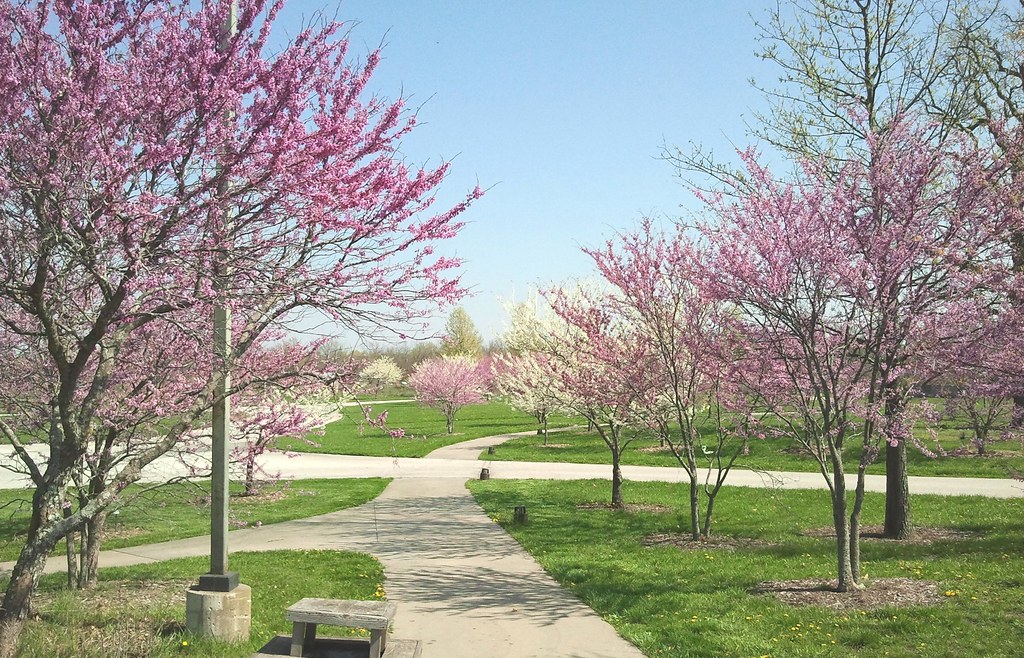
The walk from the parking lot to the Visitor Center is lined with Redbuds and Whitebuds -- someday it should create a tunnel-like experience, shading visitors as they walk from the parking lot to the building.
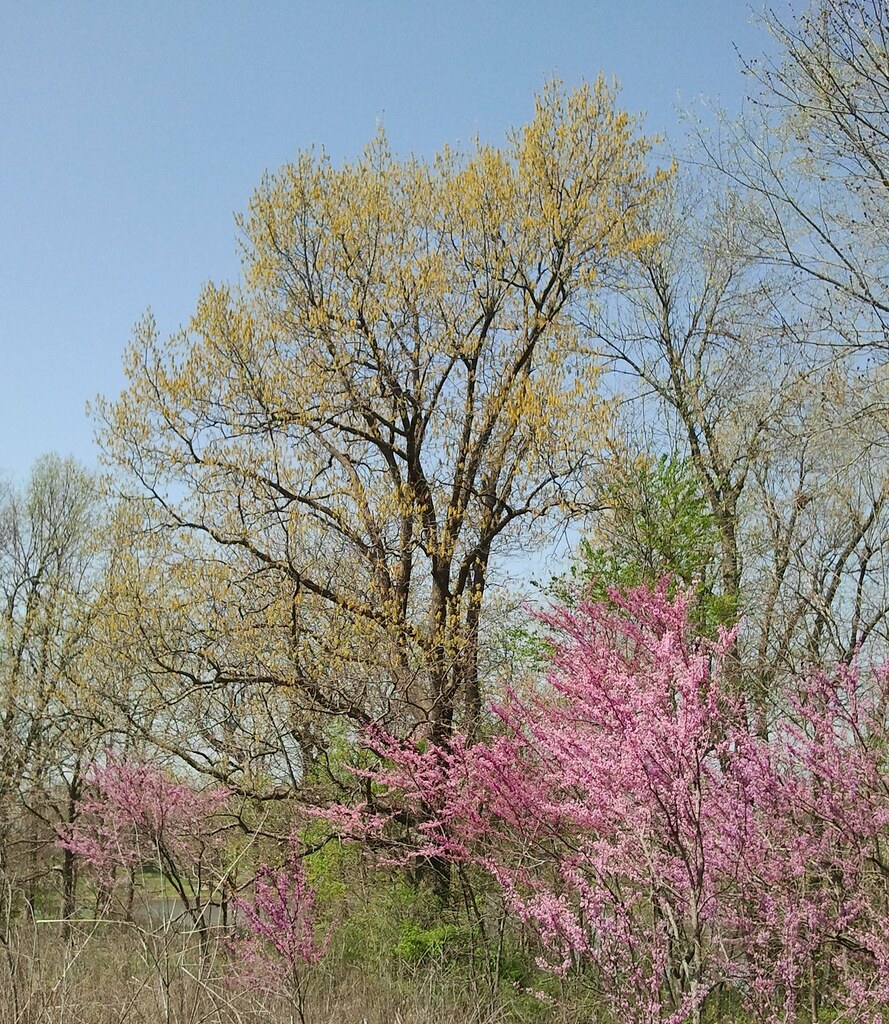
Redbuds look beautiful when growing like they would in nature: in masses at the edge of a woods. Their flower color is the perfect compliment for the yellow-greens of new foliage and less showy flowering trees like the tall Black Oak (Quercus velutina) blooming in this scene. Look for this composition between the Rock & Waterfall and Perennial Gardens.

Redbud's flower color actually is a blue-pink and looks fabulous against a blue sky and the perfect compliment for yellow-greens like the pin oak (Quercus palustris) on the right side of this image. Blue flowering plants also look beautiful beneath redbuds including native wildflowers like Virginia bluebells, Jacob's Ladder, Woodland Phlox, Butterfly Violets, and Crested Iris.
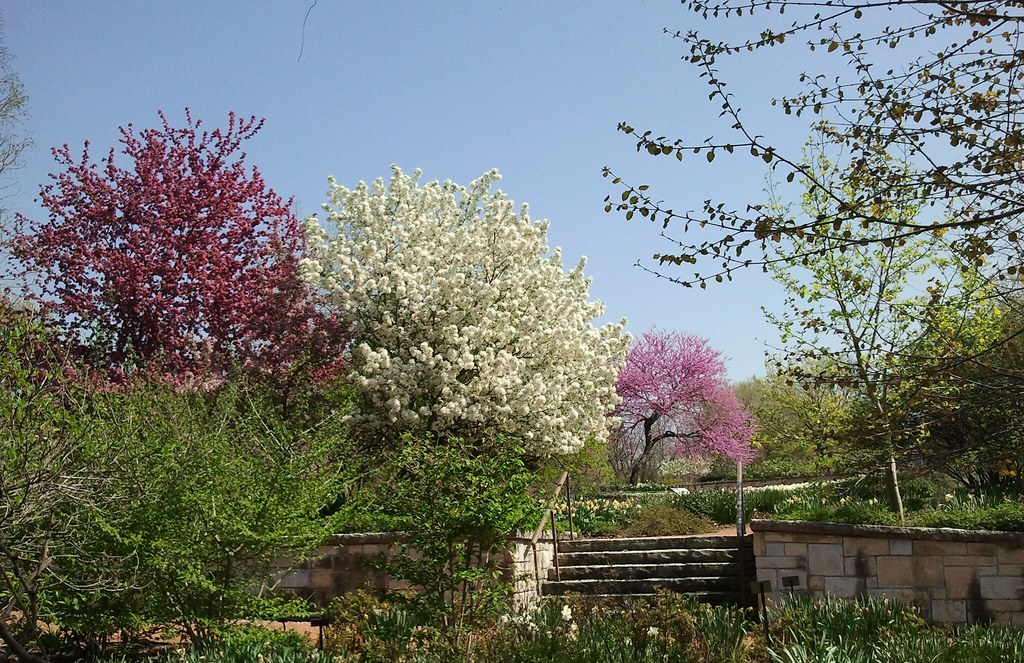
Flowering Crabapples (Malus cultivars) were also in bloom this week and this picture from the Perennial Garden shows: from left to right, a red-flowering 'American Masterpiece' crabapple, then a white 'Donald Wyman' crabapple and then a Redbud blooming beyond. Redbuds unique color CLASHES with red-flowering crabapples and pink or red-flowering dogwoods. Plant a white-flowering one to transition between these colors. Redbuds also clash with orange and red brick so be mindful of your landscape use of redbuds!

Redbuds go well with all colors of lilacs like this Mount Baker lilac (Syringa x hyacinthiflora) in white but blue or purple-flowering lilacs make beautiful compositions with redbuds.

Sunsation Magnolia is a later blooming "yellow" flowering magnolia. I think it is one of my favorites for its complex colors from lime to pink with various shades of yellow. It works exceedingly well in a planting with redbuds. Look for Sunsation Magnolia beside the Visitor Center trolley stop.
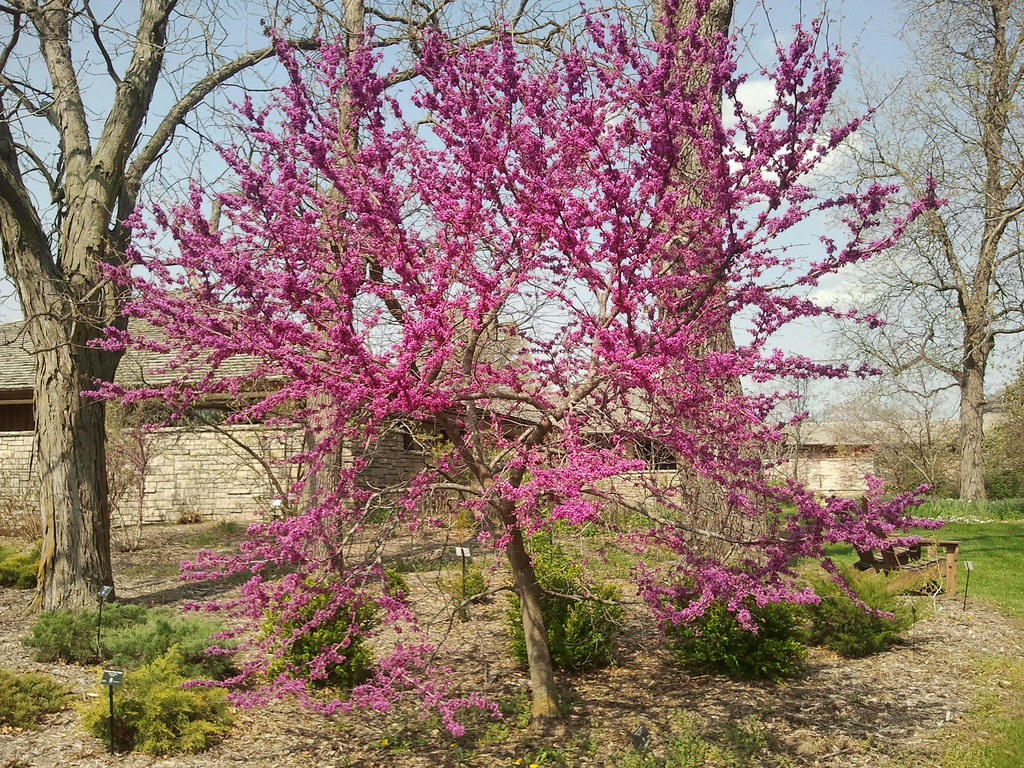
Here's and 'Oklahoma' Redbud (Cercis reniformis or C. canadensis var. texensis) which blooms a bit later with rosier colored flowers. Oklahoma Redbud was selected from the Arbuckle Mountains of Oklahoma and is exceedingly heat and drought tolerant with much more lustrous leaves than a typical redbud. This species or variety is found wild in Southern Oklahoma through Texas but is hardy here.

The Chapel's fountain (and the whole Chapel landscape) contains some of our best displays of Redbuds. Most of the Redbuds around the Chapel are Whitebuds (Cercis canadensis 'Alba') which is a cultivar that was originally found in the wild in Missouri. There is a newer cultivar 'Royal White' that is a bit hardier found in Illinois. It is hard to tell the two cultivars apart!
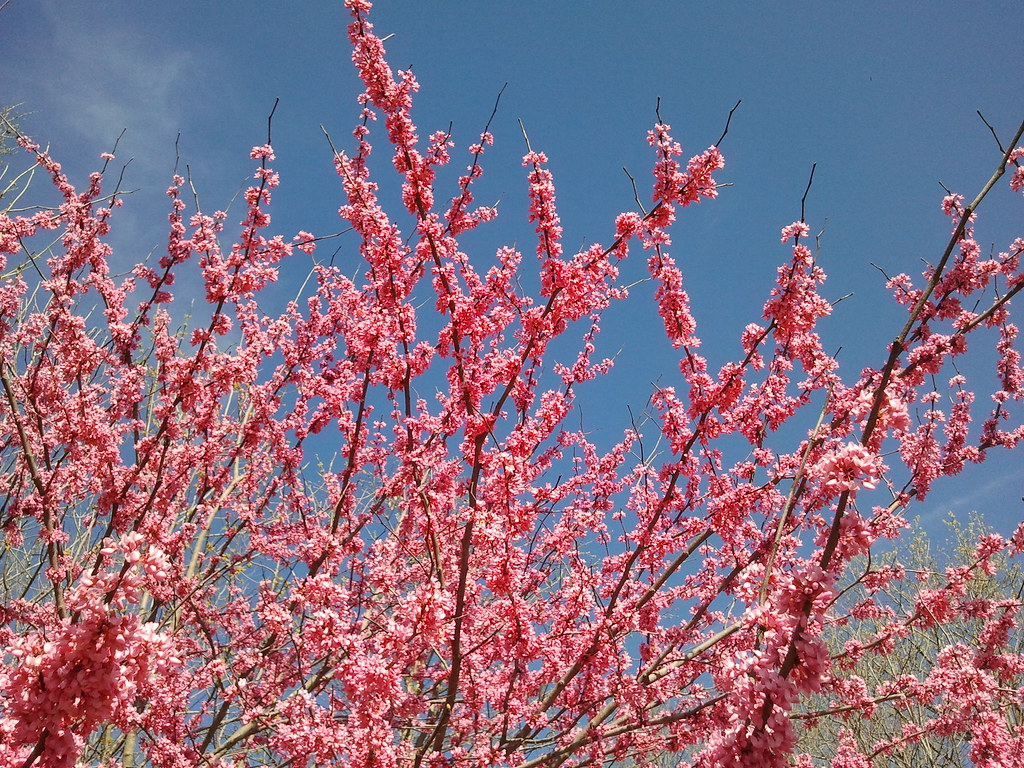
This photo is not touched up! It's Tennessee Pink Redbud growing on the walk to the Chapel. This redbud has cherry pink flowers and was a real stunner this spring. Appalachian Red is another cultivar with zippy, almost red-pink flowers.

This pinker Redbud is the older cultivar 'Rubye Atkinson' and is missing the blue overtone typical of redbuds. Look for this tree over near the Chapel Walk.

This pearly-pink Redbud is the cultivar 'Pauline Lily' and is a lovely, softest pink. Look for this tree near the Chapel trolley stop.
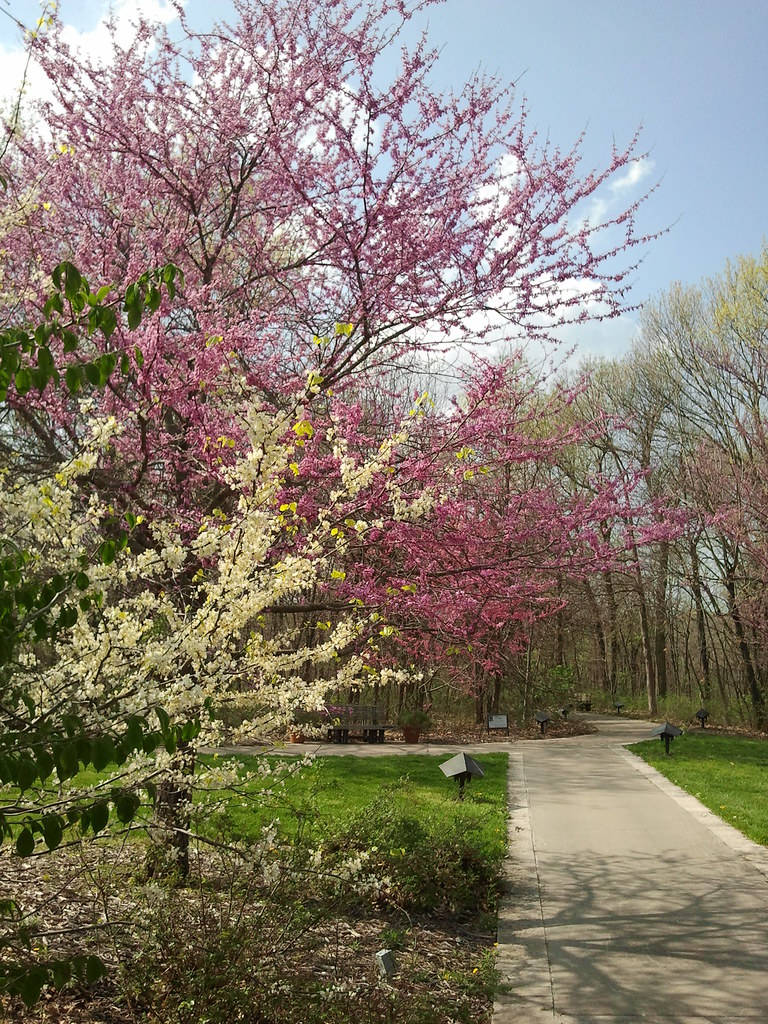
The redbud flowers are currently waning but some are still in lovely flower. (The picture is from the Chapel trolley stop looking towards the woodland walk to the Chapel.) The Flowering Dogwoods will open fully this weekend as will our Oriental wisterias on the Arbor in the Perennial Garden. Make sure to walk the Dogwood Walk from the Visitor Center to the Island Garden and over to the lakeside arbor in the Perennial Garden as it is rare for our wisterias to be so completely loaded with their purple, pendant and exceedingly fragrant blooms. Come celebrate the beauty of our landscape filled with spring-flowering trees!
Friday, April 29, 2011
Dogwoods with Dinosaurs
Dogwoods and other unique spring flowering trees are coloring the grounds for quite a horticultural experience at Powell Gardens. If you are coming to see the dinosaurs these beauties will also grab your attention as they are some of the most beautiful of all flowering trees.


The Amanogawa Cherry blossom are very cheery! Its gorgeous semi-double flowers of soft pink, age to almost white. The fact that the tree bloomed 100% after last winter was a good hardiness test. I think it has potential as a tree to bring distinction to tight spaces.

The vivacious purplish-red leaves of Emperor I Japanese Maple (Acer palmatum) stand out in the shade of the Rock & Waterfall Garden. This tree boasts beautiful spring and fall color! It is a new selection from Oklahoma's wholesale Greenleaf Nursery that is more suited to our plains climate and doesn't leaf out as early and thus set itself up for a late freeze's damage.

This NEW Redbud (Cercis canadensis 'The Rising Sun') is also very unique with sunny butter yellow new foliage! WOW, it is shockingly colored in the spring landscape and perfect for contrasting with other foliage colors. This new cultivar was brought in for us by Blue Spring's Colonial Nursery from wholesale Greenleaf Nursery and will soon become available to the general public. Look for this small tree near the Rock & Waterfall Garden's trolley stop. We also have the new 'Burgundy Hearts' Redbud with shocking new purple leaves near the Learning Shed in the Heartland Harvest Garden. Be sure and look for these and other fine flowering trees this weekend on your visit to Powell Gardens.
Wednesday, April 13, 2011
Peak of Spring in Flowers
Native redbuds and plums paint the landscape of Powell Gardens expressing that our spirit of place is at the peak of spring.  This composition of our native Eastern Redbud (Cercis canadensis) and Wildgoose Plum (Prunus munsoniana -- one of 5 species of local wild plums) welcomes visitors to Powell Gardens just before the gatehouse. Often times we gardeners embrace exotics at the expense of those that originally decorated this land in a new term I am seeing called "contempt for the familiar." The splashes of raspberry sherbet pink-flowering redbuds and fragrant sparkling white-flowering wild plums coloring our landscape make this my hands down favorite time of year.
  In the Heartland Harvest Garden's edible landscape the gorgeous flowering fruit trees have advanced to the pears taking center stage. We have the biggest variety of pears in public display anywhere around. Kikisui Asian Pear, shown above, has the most beautiful flowers of them all this spring. The ornamental callery (Bradford, Aristocrat, Chanticleer, etc...) pears (Pyrus calleryana) are popular in local landscapes but Powell Gardens has none because they are becoming the next invasive exotic to damage our wild lands. Consider the beautiful Asian edible pears (Pyrus pyrifolia) as an alternate and feed yourself instead of the starlings with the bounty of crisp, juicy pears following their bloom.
  Pears are known for their upright form and here's a mug shot of Honsui Asian Pear in bloom. You do need two varieties of Asian pears to set fruit and their narrow crowns do not take up much air space and offer unique uses in edible landscape where space is limited.
  Some of our varieties like this '20th Century' Asian Pear have coppery leaves while they bloom adding a color echo to the centers of the flowers and thus adding to the ornamental appeal of the plant. I am busy trying to keep track of all these details on our premier collection of fruit trees because edible landscaping implies you know the ornamental beauty of a edible plant along with its productivity and garden performance.
  The Daisui Li Asian Pear may have the most coppery leaves of them all at bloom time. I only had time at mid-day to capture the image so it looks better to the eye than the camera in the now August-like mid-day sun of April. Heartland Harvest Garden Horticulturist Matt Bunch ranked 'New Century' Asian Pear as the best for productivity, flavor and right size fruit in our collection; but noted that for the most part they all were good!
  This heirloom purple-leaf plum (Prunus unknown hybrid) is a pass along plant from near Liberty, MO and has delicious plums according to Matt Bunch. Its tiny pinkish-white flowers cover every stem and twig making it a bit dazzling looking and a great color with the redbuds on the edge of the Vineyard seen in the background. Remember redbud flowers and young pea pods are edible and a nice addition to a spring salad.
  I had to include a picture of the arbor at the center of the Heartland Harvest Garden 'Quilt' Gardens because the Clove Currants (Ribes odoratum) continue to grab attention with their phenomenal scent and the Akebia vines (Akebia spp.) growing up the arbors are beginning to bloom. Make sure to take a closer look and the unique flowers of the akebias varying in color from white to purple. (My close up lens is still not fixed so I can't share that with you -- you'll have to see it in person!)
  The Flowering-Quinces (Chaenomeles spp.) are in full bloom around the gardens and they are not the trash collecting shrubs they were once thought of anymore. New varieties have flowers in double petals and colors from white to blush pink to almost orange and vivid reds. This is the peachy 'Cameo' Flowering-Quince along the dogwood walk. Remember to grow quinces for their fruit as well (if you have at least 2 varieties to pollinate) which make delicious spicy preserves or natural air fresheners if you are not into the culinary experience. The double white 'O Yashima' Flowering Quince that buds greenish and whitens as it opens may be my favorite and look for it near the entrance to the Heartland Harvest Garden. New varieties for the spring plant sale have flowers almost as large as camellias!
  The late season daffodils are now at peak but other unique bulbs can be observed around the gardens. The interesting Guinea Hen Flower or Checkered Lily (Fritillaria meleagris) blooming in the Rock & Waterfall Garden is a great bulb that does best in a site that is wet in spring.
Thursday, April 7, 2011
Spring Has Sprung!
Spring has really sprung at Powell Gardens and the gardens are giddy with flowering flora. The sights and scents of the flowers are especially captivating after a winter without them in the landscape.


Friday, June 25, 2010
Midsummer's Bloom: from Lotus to Trees & Shrubs

The most magnificent flower currently in bloom in the gardens is the Mrs. Perry Slocum Lotus (Nelumbo nucifera). This water garden plant can be seen on the Island Garden though a few more weeks must pass for the Island Garden lotuses and waterlilies to be at peak season. Magnolia trees are in the same ancient Order of plants as the lotuses and waterlilies and the Southern Magnolias continue with their sporadic bloom: abuzz with bees and visitors alike. This is the Twenty-four Below Magnolia (Magnolia grandiflora) on the south side of the Visitor Center -- its flowers don't stand out in the photo.


 Golden Rain Trees (Koelreuteria paniculata) are also in full bloom around the gardens. Their warm, cheery flowers seem most appropriate in this sun drenched season. Many of our trees have suffered this year from being too wet for the third season in a row. This is a tree that demands good drainage. Golden Rain Trees can be invasive in certain areas with glade-like natural areas but has never escaped in the wet clay soils of Powell Gardens.
Hardy Mimosa trees (Albizzia julibrissin var. rosea) are also in full bloom at the gardens -- these outside the Conifer Garden outside the north end of the Visitor Center. See my blog from last year on this "you either love them or hate them" tree. This tree is native to cold Korea and is hardier and more refined than the typical species found wild from Iran to Japan.


Buttonbush (Cephalanthus occidentalis) with its marvelous spherical flowers is coming into bloom on the Island Garden. This huge, native shrub can easily be trimmed up into a small tree like we have done on the Island Garden. Its flowers are rich in nectar and visited by many beneficial and pollinating insects.

The large white pom-poms of flower make the Annabelle Hydrangea (Hydrangea arborescens) one the largest flowering of all shrubs. This is actually a selection of Missouri native Wild Hydrangea and was discovered in a garden in Anna, Illinois. Many of our best ornamental shrubs were never specifically hybridized -- just chance seedlings that were discovered by a plantsman with a good eye for promising and unusual garden plants.

The huge flowered and aptly named Bottlebrush Buckeye (Aesculus parviflora) is also a superior midsummer blooming shrub. Bottlebrush Buckeye does become a massive shrub over time -- easily 15 feet or more at maturity with twice the spread! It can be controlled by removing wayward stems and cut back on occasion if so desired. This shrub is almost exclusively native to Alabama, barely venturing into adjacent states in the wild but popular intemperate gardens world-wide!

The showy red color in this shrub is not flowers but fruit. The Shasta Doublefile Viburnums (Viburnum plicatum var. tomentosum) on the Island Garden are loaded with bright red berries this year. Often grown solely for its lacecap flowers that march down either side of its twigs (double file!), the fruit (which ripen black) are actually showy for a much longer period of time than the flowers.
 The Tapestry Hedge in the Perennial Garden just got a haircut to keep it a maximum height of 8 feet. You can see that the Perennial Garden is awash in floral color as Booms and Blooms looms for a daylily extravaganza next week.


