
Jack Frost's cousin Mr. Deep Freeze hit the gardens Sunday night -- we had a low of 20F at Powell Gardens (22F in the city at the Kauffman Memorial Garden) that ended the season for many of our fall flowers. Pansies, Violas, ornamental cabbages and kale weathered that well and fruiting plants are just as beautiful as ever so there is still a lot of beauty to see in the gardens.

Deciduous Hollies or Possumhaws (Ilex decidua) are now leafless but the female trees are simply ablaze with red holly berries. What a warming element to the late fall (and winter) landscape -- a wonderful display of these can be seen along the gatehouse landscape when you enter Powell Gardens.

Flowering Crabapple varieties that produce fruit are simply stunning now too. This is the 'Donald Wyman' Crabapple in the Perennial Garden simply loaded with small red crabapples right now. Some would argue that these fruit are messy but the varieties we display at Powell Gardens hang on to their fruit until the birds eat them. There is minimal mess, an easy price to pay for such an ornamental display that lasts for weeks and even months depending on the weather. Donald Wyman Crabapple has fleeting red-budded, white flowers in spring but a much more spectacular display of red crabapples in fall and winter.
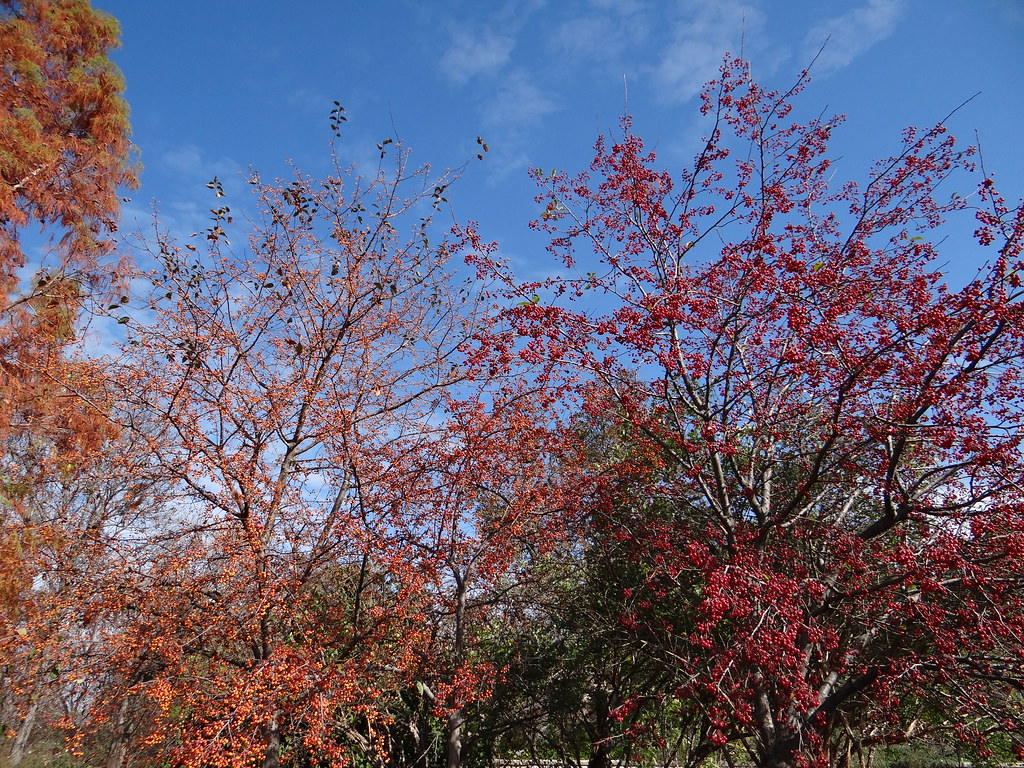
Here's another view of the Donald Wyman Crabapple (right) showing its neighbor the 'American Masterpiece' Crabapple (left). There are several varieties of crabapples with more orange fruit like 'Amercan Masterpiece' which unfortunately is no longer available. American Masterpiece has cranberry red flowers in spring and almost pumpkin orange little crabapples in fall and winter.
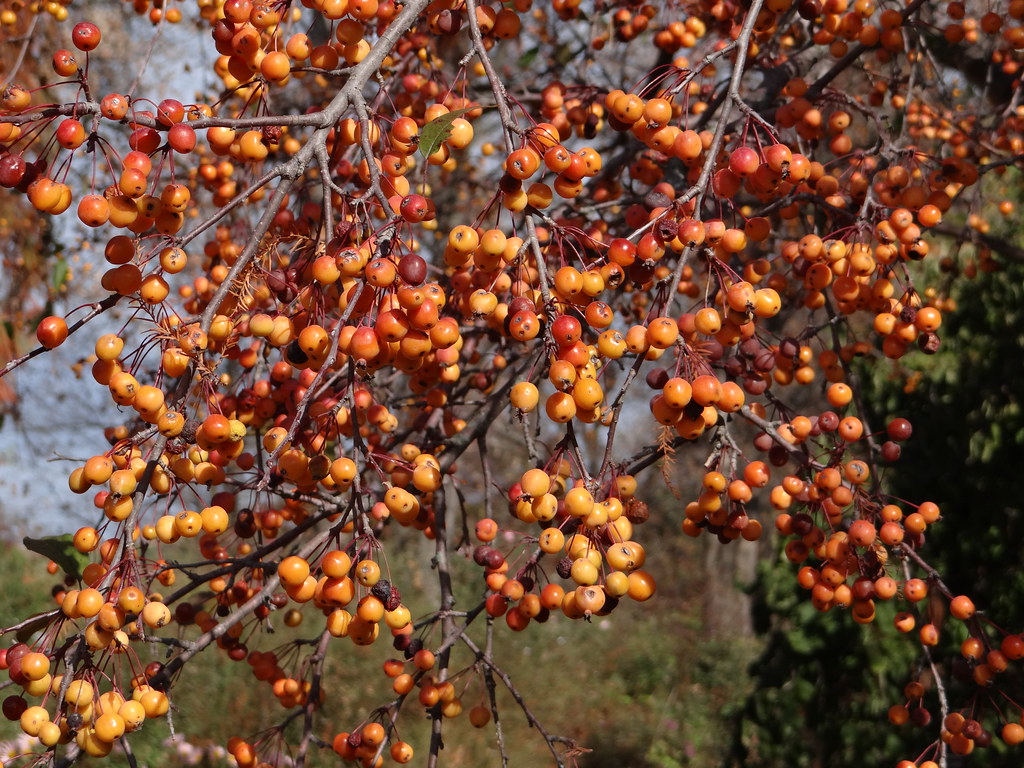
Here are the orange crabapples of 'Indian Magic' Crabapple which is widely available. It's a smaller tree with purplish-red flowers in spring. Our tree of this is wedged between the much more vigorous Donald Wyman and American Masterpiece Crabapples in the prior image.
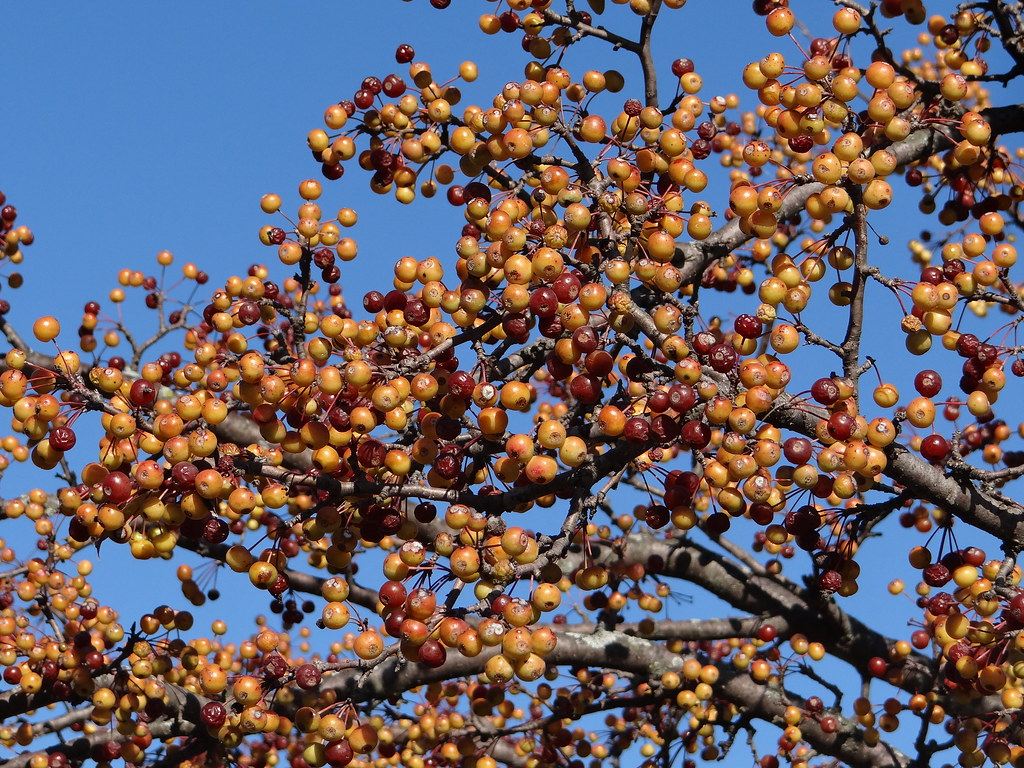
Tea Crabapples (Malus hupehensis) are bronzy orange now too, as they age you can see some are turning redder. These trees have a beautiful vase shape but grow quite large over time. Look for these at the west (Visitor Center) entrance to the Island Garden.
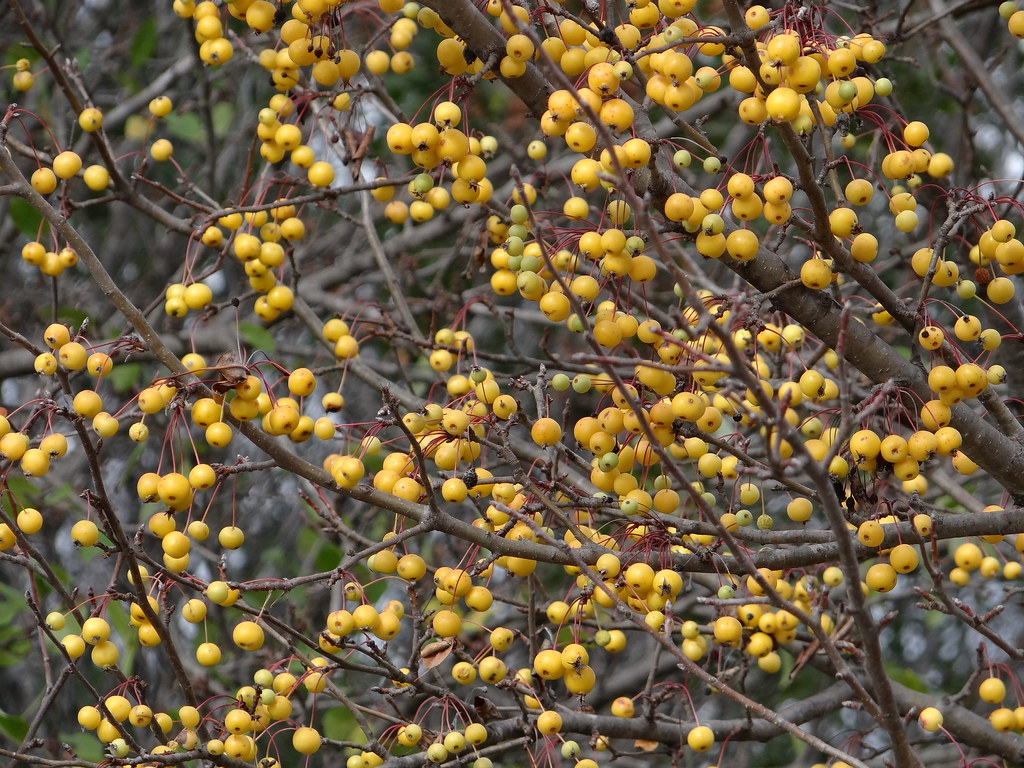
Yes, crabapples come in yellow too! Here are 'Harvest Gold' crabapples which are such a warm yellow at this season. Their spring flowers are red-budded opening to white, fragrant flowers. Night lighting is reflected beautifully from these too. The color of the yellow crabapples holds until eaten by birds or a severe freeze (colder than 10F) makes them turn bronze. Look for Harvest Gold Crabapples on the east (Meadow) side of the Island Garden.
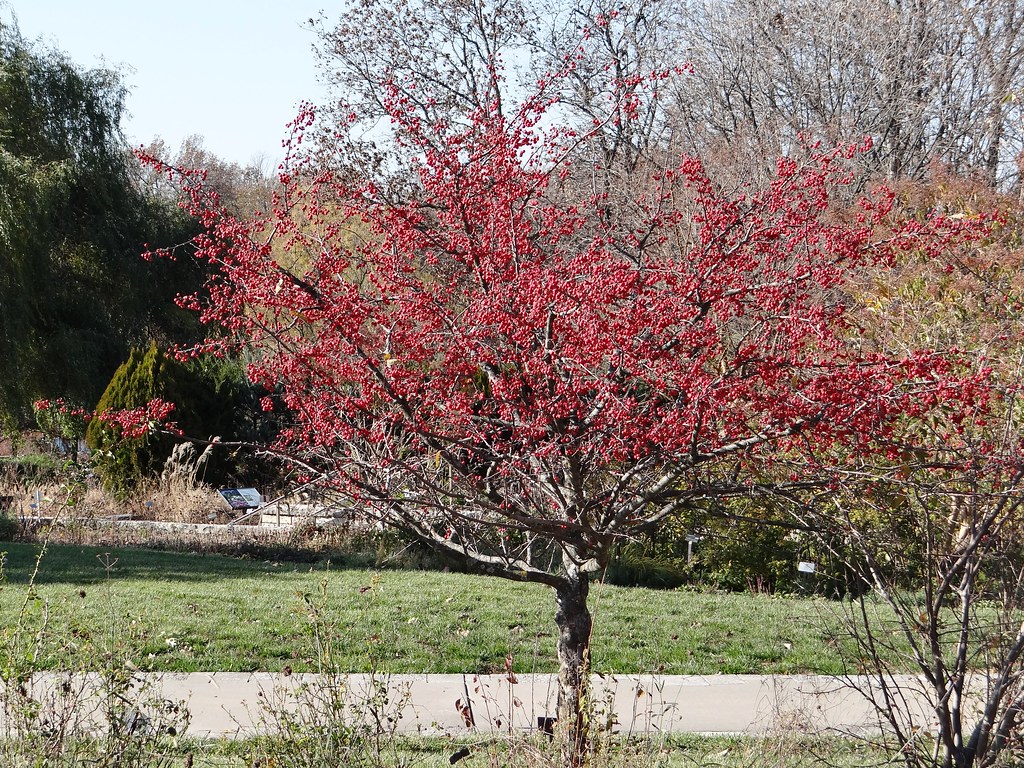
Here's a 'Sugar Tyme' crabapple on the edge of the Perennial Garden. It has very nice fruit set too and stays a smaller tree -- what most nurseries are going for now. When selecting a crabapple I always start with learning if it is a disease resistant variety (all described above are very disease resistant here). Secondly I look at its mature size (most grow taller than wide). Thirdly I pick them for their fruit display and I pick them last for their flowers! Ornamental crabapples are phenomenal plants for wildlife friendly gardens. Their fruit is a staple of many fall and winter birds. They are also host to many beneficial insects and unlike most non-native plants, our native insects readily transfer from our disease-prone native crabapples to these more garden ornamental varieties. Crabapples are also NOT invasive like ornamental pear trees in our region.
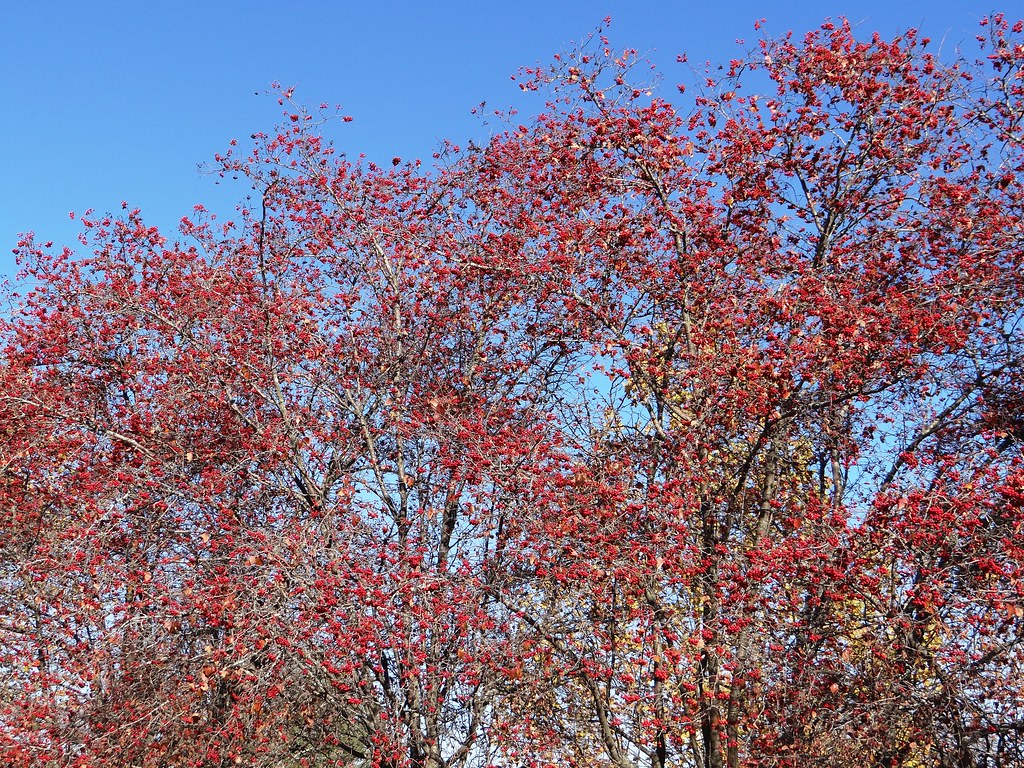
The Washington Hawthorns (Crateagus phaenopyrum) are also beautiful at Powell Gardens right now as the leafless trees are completely cloaked in red fruit. The dry year helped them out as they can be very disfigured by cedar-quince rust disease -- a reason we no longer recommend them. Look for them by our trial beds near the old visitor center. Hawthorns are a beautiful and important part of our native flora so we do have them in the wilder parts of the garden including 3 native species along the Nature Trail: Frosted Hawthorn (Crataegus pruinosa), Red or Downy Hawthorn (C. mollis) and Cockspur Hawthorn (C. crus-gallii).
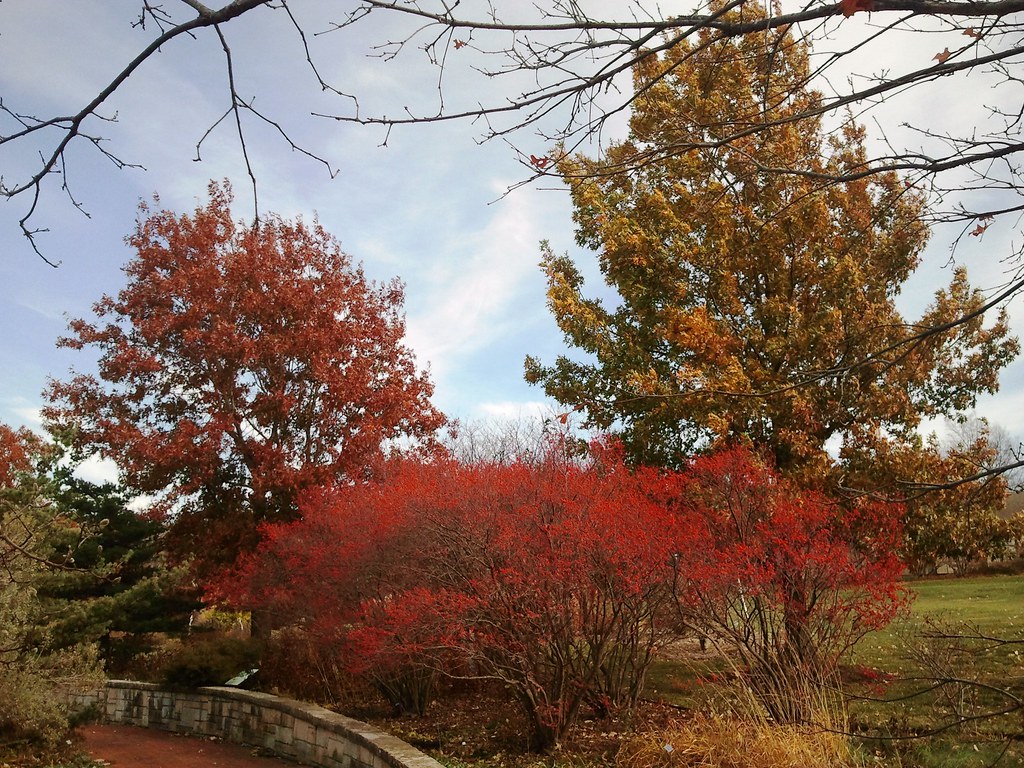
The blazing red shrubs in the above image are 'Sparkleberry' Hollies (Ilex serrata) in fruit in the Perennial Garden. Behind them are Shumard Oaks (Quercus shumardii) which are very late in their fall color -- some Shumard Oaks usually have no fall color while others can be a nice red. So there is still much beauty in the late fall garden, most specifically the brilliant fruit of fall-fruiting plants.
Thursday, November 15, 2012
Berried Trees Enliven the Late Fall Landscape


Thursday, October 14, 2010
Autumn Visions in the Garden
Mid Autumn is already here and the weather has been simply spectacular. The colors of the season are starting to charm the visitor and speak to the spirit of this Midwestern Garden.
A Cherokee Sunset Flowering Dogwood (Cornus florida) shade a patch of vibrant impatiens for some striking color combinations. Look for this composition near the Hummingbird Garden outside the Visitor Center.
Purple Dahlia Zinnia (Zinnia elegans) continues to thrive and bloom in the Hummingbird Garden even though our hummingbirds have all migrated southward. This is one of two seed strain Zinnias we love for nectaring butterflies and hummingbirds as well as for disease resistant foliage. Most zinnias would be rubble mired in mildew after this past wet season.

Mexican Sunflowers (Tithonia rotundifolia) continue to sport their velvety orange blossoms so apropos for the season. I like the background of burgundy Flowering Dogwood fall foliage in this shot from the Hummingbird Garden.

A walk down the Dogwood Walk to the Island Garden is well worth the exercise! The views from the Island Garden to the chapel are stunning when framed by Maximillian's Sunflower and prairie grasses at the peak of their fall colors.

The Aromatic Asters (Aster oblongifolius) in the Island Garden's living wall's eastern end are awash in bloom. Make sure to look at all the butterflies and beneficial insects visiting the flowers as you walk past.

The meadow is in full autumn attire with blooming asters (New England Aster Aster novae-angliae depicted) with various seedheads (Illinois Bundle Flower Desmodium illinoiense) and grass seed heads (Giant Foxtail Setaria italica) set off by billowing masses of local prairie grasses.

Many of our oak trees are just starting to turn colors like this stalwart Post Oak (Quercus stellata) growing on the edge of the Rock & Waterfall Garden. This is one of our toughest native trees and should be planted more often but doesn't conform to nursery production. It is a tree that withstands everything that Mother Nature can throw at it from heavy ice load to extreme heat and drought.

Shagbark Hickories (Carya ovata) are also turning shades of yellow and are another tried and true native tree here. They also don't conform to nursery production so are never available for homeowners to plant. Look for many of these trees with classic shaggy bark in the Rock and Waterfall Garden.

The Pawpaws (Asimina triloba) are also turning their characteristic shades of pale yellow in the understory of the Rock & Waterfall Garden. This tree is becoming more popular in gardens as edible landscaping themes gain mainstream acceptance. If you've never eaten a pawpaw fruit before, be sure and visit Powell Gardens next early to mid-September next year to sample a pawpaw at the tasting stations in the Heartland Harvest Garden.

Grasses are a mainstay of local autumn gardens and here huge 'Guilded Tower' Giant Miscanthus (Miscanthus x giganteus) stands left of lovely 'Autumn Red' Miscanthus (Miscanthus sinensis) near the Perennial Garden trolley stop. Note the heavily fruited 'Centurion' Crabapple in the background which adds to the autumn colors of this composition.

Tall Tails Fountain Grass (Pennisetum orientale) always is a fun blast of seedheads in this season. Look for this mass with complimentary crabapple and chrysanthemums also near the Perennial Garden trolley stop.

'Hameln' Fountain Grass (Pennisetum alopecuroides) also acquires some nice fall hues and looks great with various chrysanthemums in the Perennial Garden.

Many shrubs throughout the gardens are studded in autumn fruit. This is a rare cultivar of Missouri native Southern Arrowwood (Viburnum dentatum) called 'Firework' because the stems of the blue berries are bright red.

Another Viburnum with striking fruit now is the Linden Viburnum (Viburnum dilatatum): this is the heavy fruiting cultivar 'Asian Beauty.'
Tuesday, October 27, 2009
Peak Fall Color 2009!


 A fall-blooming species crocus got mixed in with a purchase of saffron crocus bulbs.
Thursday, October 8, 2009
Fall is in the Air
Fall is in the air with the first frost on the grounds on Wednesday morning, October 7, 2009. The frost was not universal so most tender plants were not nipped. Wednesday was a glorious day without a cloud in the sky until late afternoon.
The Chinese Pistache (Pistachia chinensis) in the nursery has turned a beautiful shade of red. This tree is on trial (two full years now) for the Heartland Harvest Garden as its new shoots are edible and used in China as a vegetable. This tree is well known for its outstanding fall color but is of marginal hardiness in Greater Kansas City. There are good trees from Wichita, Kansas southward. Trees as far south as Tulsa have been killed by past severe winters. Does anyone know of a large, established tree in the Kansas City region? Despite being sold at many stores and nurseries we know of no local, established trees.
Possumhaw a.k.a. Deciduous Holly (Ilex decidua) berries have now ripened and are a brilliant red. Possumhaw berries are showiest after its leaves drop and often hang on the small tree and remain colorful into mid-winter or beyond. I find it one of our most outstanding fall and winter ornamentals. Look for groves of this plant off to the right side of the gatehouse when you enter Powell Gardens. I wrote a plant profile article about this plant that should be in the November issue of The Kansas City Gardener.
Blueberries (Vaccinium corymbosum and hybrids) are turning wild shades of red. The cultivar 'Jersey' is depicted but look for 27 varieties on display in the Heartland Harvest Garden. Be sure and come visit while they are in bloom next spring and certainly don't miss tasting their abundant blue berries on a visit next summer.


